
Nigella sativa L.: What Does the Science Say About Black Seed?
Black seed, black cumin or Kalonji (کلونجی) is familiar in many kitchens and traditional healthcare practices. Its scientific name, Nigella sativa L., also appears increasingly in research on glucose regulation, blood lipids, inflammation and cellular responses to injury.
For Biomedical Scientists, it provides a useful example of how natural-product research connects chemistry, experimental biology and laboratory medicine. The challenge is to distinguish a plausible mechanism or an improved biomarker from a treatment that produces meaningful benefits for patients.
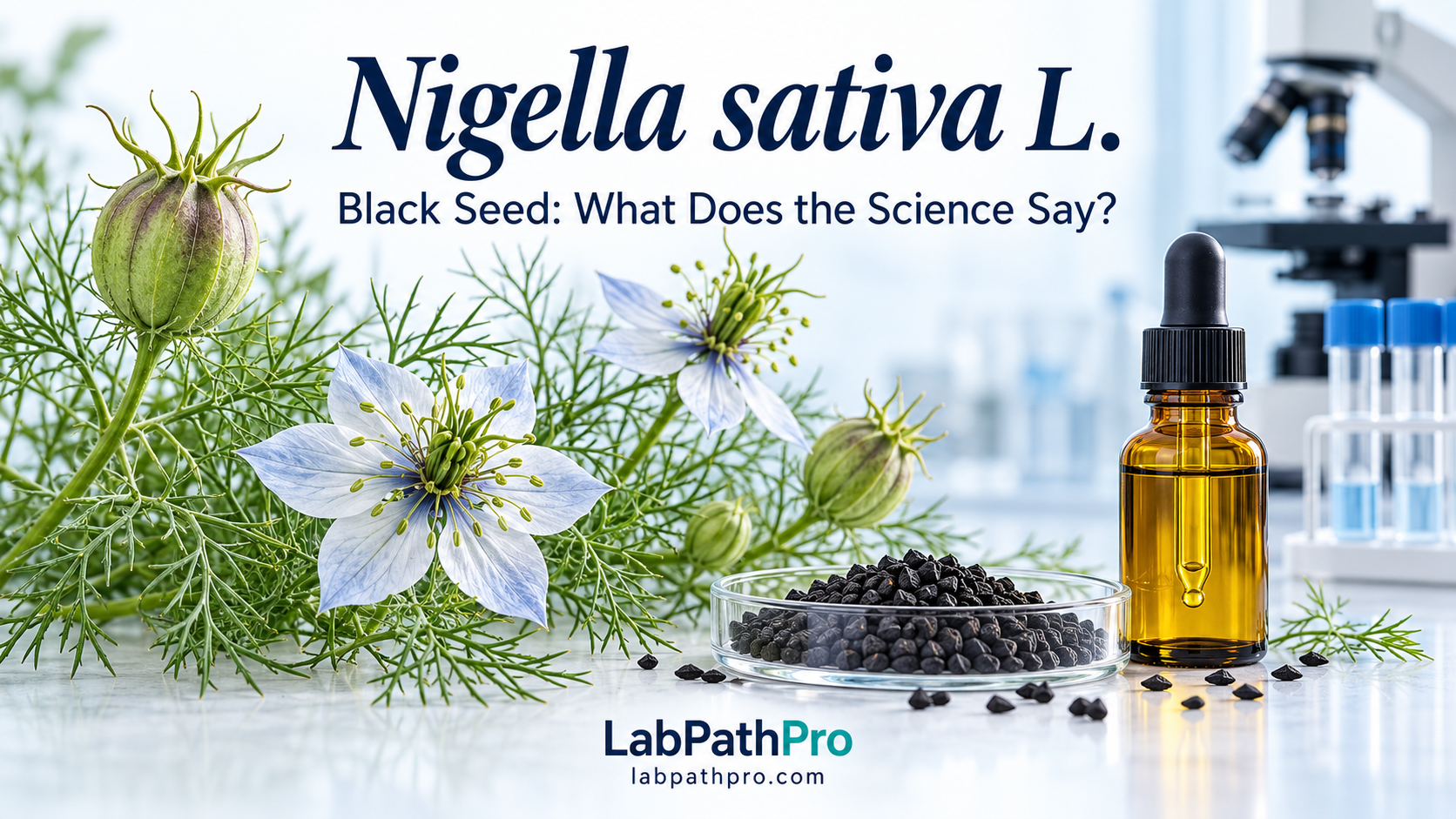
What is Nigella sativa?
Nigella sativa is an annual flowering plant belonging to the Ranunculaceae family. Kew identifies its native range as extending from Romania to western and south-western Iran 1. Its seeds are used as a spice and are also processed into oils, extracts and capsules.
| Feature | Description |
|---|---|
| Scientific name | Nigella sativa L. |
| Family | Ranunculaceae |
| Common names | Black seed, black cumin and Kalonji |
| Parts commonly used | Seeds and seed oil |
| Widely studied constituent | Thymoquinone |
Common names can be ambiguous. Scientific identification matters when comparing studies or assessing commercial products: a familiar name alone does not establish botanical identity or chemical composition.
Traditional use helps explain why a plant attracts research interest. Clinical effectiveness still needs to be assessed for a particular preparation, indication and patient group.
Why are its chemical constituents interesting?
The seeds contain fixed oils, including fatty acids such as linoleic and oleic acids, alongside volatile constituents and other phytochemicals. Thymoquinone, a quinone compound, is among the most extensively investigated components. Other constituents include thymohydroquinone, thymol, carvacrol and the saponin alpha-hederin 2.
Experimental studies have investigated effects on inflammatory signalling, oxidative stress, metabolic enzymes and cell survival. These findings suggest biological activity, rather than proving a general health benefit.
The distinction between products is essential. A seed-powder capsule, a fixed seed oil, an essential oil and purified thymoquinone have different compositions. Extraction, storage and formulation can affect what is delivered. A study of one preparation cannot establish an equivalent effect for every product labelled “black seed”.
Laboratory context: identifying and quantifying a constituent is an analytical question. Establishing whether a standardised product improves patient outcomes is a separate clinical question.
What do recent clinical reviews show?
The broad 2025 cardiovascular-risk review
A review in Pharmacological Research included 82 studies involving 5,026 participants, with 79 contributing to quantitative analysis. Interventions lasted between 1 and 48 weeks, and the literature search extended to August 2024 3.
The authors reported favourable pooled changes across several cardiometabolic and inflammatory markers, including glucose, HbA1c, blood lipids and blood pressure. This supports further investigation of an adjunctive role. It does not demonstrate that supplementation prevents cardiovascular events.
The 2025 review in type 2 diabetes
Karimi and colleagues analysed 16 randomised controlled trials in people with type 2 diabetes 4. Reported mean reductions included:
| Marker | Pooled difference | Approximate equivalent in UK laboratory units |
|---|---|---|
| Fasting glucose | −21.43 mg/dL | −1.19 mmol/L |
| HbA1c | −0.44 percentage points | −4.8 mmol/mol |
| LDL cholesterol | −19.53 mg/dL | −0.51 mmol/L |
UK-unit values are rounded conversions of the reported differences. They are study averages, not predicted changes for an individual.
These findings suggest potential additional effects on glycaemia and lipids. They do not establish equivalence to prescribed diabetes medicines or statins, and should not be used to justify stopping established treatment.
A 2026 review adds useful detail
A GRADE-assessed review by Musazadeh and colleagues included 31 trials involving 2,145 participants 5. Pooled estimates included reductions of approximately 3.25 mmHg in systolic blood pressure, 2.75 mmHg in diastolic pressure and 0.56 percentage points in HbA1c. However, the review did not find significant effects on insulin, HOMA-IR or several measures of central adiposity.
The authors described the improvements as modest and highlighted variability in study quality and outcomes. Publication date also needs interpretation: this 2026 review searched the literature to July 2024. A newer publication does not necessarily contain newer trials.
Reviews may include overlapping studies. Their participant totals should not be added together as though they represent entirely separate evidence.
How might thymoquinone act?
Research has investigated whether thymoquinone and other constituents alter inflammatory mediators, antioxidant responses and pathways involved in metabolism 2. One frequently studied target is NF-κB, a transcription factor involved in inflammatory gene expression.
These observations help generate testable hypotheses. They do not establish that a person taking an oil capsule will reach the same tissue concentration or experience the same effect as cells exposed directly to an experimental compound.
An “antioxidant” result also needs definition. A chemical assay measuring radical-scavenging activity, a change in an animal’s antioxidant enzymes and a reduction in human disease risk are different outcomes.
What do newer 2026 studies contribute?
Kidney-injury research: promising animal findings
A September 2026 study investigated N. sativa extract in rats with cisplatin-induced acute kidney injury 6. Researchers reported reduced histological damage and changes in Nrf2-related and renal transporter gene expression. Urea decreased in one treatment group.
Importantly, the study assessed gene expression rather than transporter function. The authors therefore described associations rather than a demonstrated causal mechanism. These animal findings do not establish that black seed prevents or treats AKI in humans, or that people receiving chemotherapy should take it.
Microbiome research: an exploratory human pilot
A September 2026 pilot study examined seed oil and thymoquinone metabolism in eight healthy adults 7. It was an open-label study, with four participants receiving supplementation and four receiving none. Its exploratory design provides preliminary observations for future research.
With such small groups and no placebo control, it cannot establish that supplementation improves gut health or surgical outcomes. It illustrates why “studied in humans” is not, by itself, evidence strong enough for routine clinical use.
Why do laboratory markers need careful interpretation?
Many black-seed studies use laboratory endpoints. Biomedical Scientists can help assess whether these measurements support the conclusions drawn.
| Marker | What it can contribute | Interpretation question |
|---|---|---|
| Fasting glucose and HbA1c | Assessment of glycaemic control | Were sampling conditions, treatment changes and study duration appropriate? |
| LDL cholesterol and triglycerides | Assessment of lipid-related risk factors | Were diet, weight change and lipid-lowering medicines accounted for? |
| CRP and inflammatory cytokines | Evidence about inflammatory activity | Could infection, obesity or another condition explain the change? |
| ALT, AST and creatinine | Information about biochemical changes and safety | Was an isolated concentration change overinterpreted as organ protection? |
| Oxidative-stress measurements | Exploration of biological mechanisms | Was the method validated, and is the endpoint clinically meaningful? |
A biological effect is different from analytical interference. If a supplement changes glucose metabolism, the measured glucose may change because the patient’s biology changed. Analytical interference means that a substance distorts the measurement procedure itself. The studies discussed here do not establish a general interference effect across routine analysers.
Before attributing an unexpected result to a supplement, investigate according to the local SOP and consider specimen quality, medication history, analytical performance and the clinical context.
What remains uncertain?
The evidence does not justify describing black seed as a cure-all. In particular, these cardiometabolic reviews do not establish cancer treatment, prevention of cardiovascular events or replacement of conventional care.
Important questions include:
- Product consistency: were species, preparation and active-constituent content verified?
- Trial quality: were allocation, blinding and outcome reporting adequate?
- Clinical relevance: how large was the effect, and how precise was its confidence interval?
- Background treatment: did other medicines or lifestyle changes differ between groups?
- Duration and safety: were follow-up and adverse-event reporting sufficient?
- Generalisability: does the studied population resemble the people to whom a claim is being applied?
A meta-analysis combines available research; its conclusions remain dependent on the quality and comparability of that research.
Safety, preparations and medicine interactions
Using seeds as a culinary ingredient is different from taking concentrated supplements. Trials have used diverse formulations and doses; there is no universally established therapeutic dose that can be recommended from these findings.
Memorial Sloan Kettering reports contact dermatitis and other adverse reactions associated with topical oil. It also identifies possible interactions involving CYP2D6 and CYP3A4, while noting that clinical relevance is uncertain. Its warfarin caution is based on experimental evidence and does not establish a predictable interaction in patients 8.
Because clinical studies report glucose- and blood-pressure-lowering effects, people taking medicines for these conditions should discuss supplements with a pharmacist or clinician. Anticoagulant use, cancer treatment and other regular medicines also warrant an individual interaction review. Pregnancy, breastfeeding and prolonged supplement use require particular caution because adequate safety evidence is limited.
“Natural” describes a source, not a guarantee of safety. Supplement use should be disclosed during medication review, and should not replace prescribed treatment.
Using this topic for CPD and IBMS portfolio learning
This topic can support learning about evidence appraisal, metabolism, laboratory markers and professional communication.
A useful activity is to compare one human meta-analysis with one experimental study. Describe the population or model, preparation, outcome, limitations and relevance to laboratory practice. Explain why a change in a biochemical marker may support a hypothesis without establishing improved clinical outcomes.
Reflection prompts:
- How does a biomarker differ from a patient-centred outcome?
- Why are seed oil and purified thymoquinone not interchangeable interventions?
- What information would help assess an unexpected laboratory result in a person taking supplements?
- How would you explain promising findings without overstating their clinical significance?
Portfolio evidence should reflect your own understanding and, where applicable, supervised practice. Map it only to the outcomes actually demonstrated.
Frequently asked questions
Does black seed lower cholesterol or glucose?
Some clinical trials and pooled analyses report reductions. The magnitude varies, and the findings support further investigation rather than a guaranteed individual response.
Is thymoquinone a proven cancer treatment?
No established clinical role as a cancer treatment is demonstrated by the evidence discussed here. Experimental activity should not be presented as an alternative to oncology care.
Can an improved blood result prove that a supplement worked?
A before-and-after result alone cannot separate a supplement effect from changes in medicines, diet, illness, weight or measurement variability.
What is the most defensible current role?
Nigella sativa is a food ingredient and a subject of active pharmacological research. Clinical evidence suggests possible adjunctive cardiometabolic benefits, with unresolved questions about standardisation, long-term outcomes and safety.
References and further reading
- Royal Botanic Gardens, Kew. Nigella sativa L. Plants of the World Online. Botanical record.
- Alberts A, et al. (2024). Review of Nigella sativa: therapeutic potential, pharmacology and clinical applications. International Journal of Molecular Sciences, 25(24), 13410. doi:10.3390/ijms252413410.
- Jafari A, et al. (2025). Cardiovascular risk factors: systematic review and dose-response meta-analysis of 82 trials. Pharmacological Research, article 107882. PubMed.
- Karimi M, et al. (2025). Black seed and cardiometabolic indices in type 2 diabetes: systematic review and meta-analysis. Complementary Therapies in Medicine, 90, 103174. PubMed.
- Musazadeh V, et al. (2026). Nigella sativa supplementation and cardiometabolic health in metabolic disease: GRADE-assessed meta-analysis. Endocrinology, Diabetes & Metabolism, 9(2), e70207. doi:10.1002/edm2.70207.
- Alipanah-Moghadam R, et al. (2026). Nigella sativa, Nrf2-related expression and renal transporters in a rat cisplatin-AKI model. Scientific Reports. doi:10.1038/s41598-026-70239-5.
- Prospective randomised pilot study of seed oil, gut microbiome modulation and thymoquinone metabolism in healthy volunteers. (2026). Scientific Reports. PubMed.
- Memorial Sloan Kettering Cancer Center. Nigella sativa: evidence, adverse reactions and interactions. Clinical information.
Evidence checked: 18 October 2026. This is a focused educational overview, not an exhaustive systematic review. Educational content only; it does not replace individual medical advice, current professional guidance or local laboratory procedures.
Continue your biomedical science learning
Explore our evidence-based practice guide, CPD guidance and Learning Centre. For related laboratory context, read our creatinine, eGFR and AKI article.
Educational use only: this article supports learning and professional discussion. It does not replace current national guidance, manufacturer instructions, local SOPs, formal risk assessment, clinical advice or professional judgement. Please read the full LabPathPro Disclaimer and Professional Notice.