High Ferritin Levels: Causes, Blood Tests and What Your Results Mean
High ferritin does not always mean too much iron. Learn what ferritin measures, why levels rise, how transferrin saturation helps, and how Clinical Biochemistry laboratories investigate abnormal results.
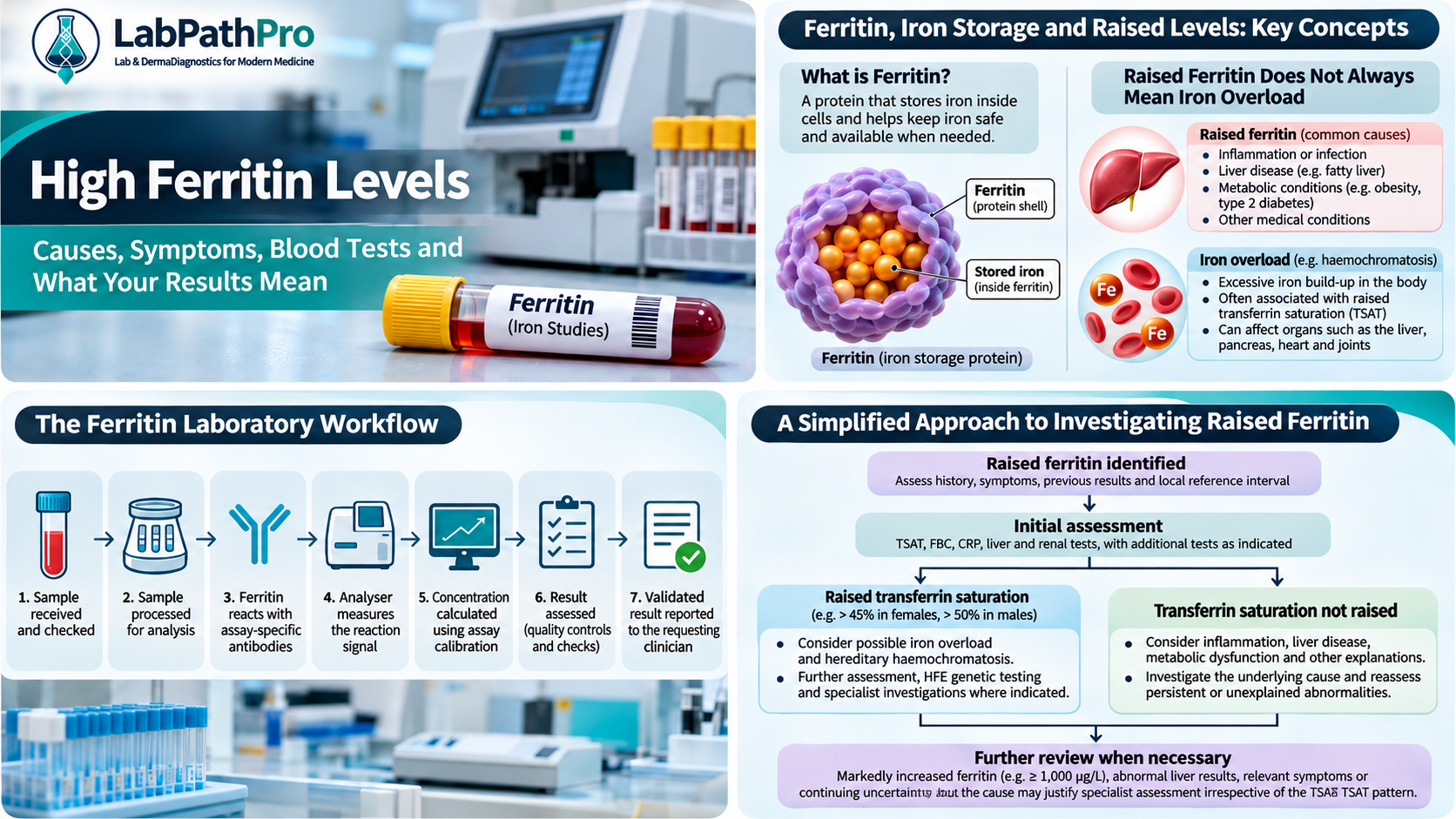
Introduction
A blood test showing a high ferritin level can be confusing. Ferritin is strongly associated with iron storage, so it is natural to assume that a raised result means there is too much iron in the body.
However, this is not always the case.
Ferritin is a protein that stores iron inside cells, but it is also an acute-phase protein. This means its concentration can increase during inflammation, infection and several other medical conditions.
A raised ferritin result therefore needs to be interpreted alongside the patient’s symptoms, medical history and other laboratory tests.
One of the most useful additional investigations is transferrin saturation (TSAT), which provides information about the proportion of the blood’s iron-transport protein that is carrying iron.
In this LabPathPro guide, we explain:
- what ferritin is;
- why ferritin levels increase;
- the difference between raised ferritin and iron overload;
- how ferritin is measured in the laboratory;
- why transferrin saturation is important;
- which additional blood tests may be required;
- how hereditary haemochromatosis is investigated; and
- the role of Biomedical Scientists and Clinical Biochemistry laboratories in producing reliable results.
What is ferritin?
Ferritin is an iron-storage protein.
Iron is essential for normal human physiology. It is required for haemoglobin production, oxygen transport, cellular metabolism and the function of many enzymes.
However, excess free iron can be harmful because it can participate in chemical reactions that generate reactive oxygen species and contribute to cellular damage.
The body therefore needs a safe way of storing iron.
Ferritin provides this storage system.
Inside ferritin, iron can be stored in a controlled form and made available when required.
Ferritin is found throughout the body, but important stores are present in tissues such as the:
- liver;
- spleen;
- bone marrow; and
- cells of the reticuloendothelial system that recycle iron from ageing red blood cells.
Small amounts of ferritin circulate in the bloodstream. Measuring this circulating ferritin provides useful information about iron status.
Ferritin is more than an iron-storage marker
An important limitation is that ferritin is also an acute-phase reactant.
During inflammation or infection, changes in cytokine signalling and iron regulation can increase ferritin concentrations independently of total body iron stores.
This means that:
This principle is central to the investigation of raised ferritin. 12
What is a ferritin blood test?
A serum ferritin test measures the concentration of ferritin circulating in the blood.
Ferritin testing is commonly used to help investigate:
- suspected iron deficiency;
- anaemia;
- persistent fatigue;
- abnormal iron studies;
- possible iron overload;
- hereditary haemochromatosis;
- some liver conditions; and
- patients whose iron status requires monitoring.
A venous blood sample is collected and sent to the laboratory for analysis.
Ferritin is usually reported in:
micrograms per litre — µg/L
You may also see ferritin expressed as ng/mL. For ferritin, these units are numerically equivalent.
Which blood tube is used for ferritin?
The specimen required depends on the laboratory and analytical system.
For example, University Hospitals Birmingham NHS Foundation Trust currently specifies serum for routine ferritin testing in adults, with lithium-heparin plasma also accepted for paediatric testing according to its local test directory.
A serum sample is commonly collected into a gold-top serum separator tube (SST).
Local laboratory instructions should always take priority because sample requirements can differ between organisations and analytical platforms.
What is a normal ferritin level?
There is no single ferritin reference interval that applies to every patient and every laboratory.
Reference intervals can vary according to:
- sex;
- age;
- physiological circumstances;
- analytical method;
- population used to establish the interval; and
- local laboratory validation.
For example, University Hospitals Birmingham currently publishes the following locally derived adult reference intervals:
| Group | Ferritin reference interval |
|---|---|
| Adult females | 20–235 µg/L |
| Adult males | 22–501 µg/L |
These figures are examples from one NHS laboratory and should not be used as universal reference intervals.
Always interpret a result against the reference interval provided by the laboratory that performed the test. 5
Reference interval versus diagnostic threshold
These are not the same thing.
A reference interval describes the distribution expected in a defined reference population.
A clinical decision threshold is a concentration used in a particular clinical context to help guide investigation, diagnosis or treatment.
For this reason, being outside a laboratory reference interval does not automatically establish disease, and being inside it does not necessarily exclude disease.
What causes high ferritin levels?
High ferritin is sometimes called hyperferritinaemia.
It is a laboratory finding rather than a diagnosis.
There are several important causes.
1. Infection and inflammation
Inflammation is a common reason for raised ferritin.
During inflammatory responses, ferritin production and iron regulation change.
Raised ferritin may therefore occur with:
- acute infection;
- chronic inflammatory disease;
- autoimmune and rheumatological disorders; and
- significant tissue inflammation.
A C-reactive protein (CRP) measurement can sometimes provide additional evidence of an inflammatory response.
2. Liver disease
The liver plays a major role in iron metabolism and ferritin storage.
Ferritin may increase in conditions such as:
- alcohol-related liver disease;
- viral hepatitis;
- metabolic dysfunction-associated steatotic liver disease (MASLD);
- acute liver injury; and
- other chronic liver disorders.
Liver function tests may therefore form an important part of the investigation.
These commonly include measurements such as:
- alanine aminotransferase (ALT);
- alkaline phosphatase (ALP);
- bilirubin;
- albumin; and
- other tests depending on local practice.
3. Metabolic dysfunction
Raised ferritin can occur alongside metabolic conditions such as:
- obesity;
- insulin resistance;
- type 2 diabetes;
- dyslipidaemia; and
- metabolic fatty liver disease.
In these patients, ferritin can be raised without the biochemical pattern expected in classical hereditary haemochromatosis.
4. Hereditary haemochromatosis
Hereditary haemochromatosis is an inherited disorder in which excessive iron absorption can result in progressive iron accumulation.
The most common form is associated with variants affecting the HFE gene.
If clinically significant iron overload develops, iron can accumulate in organs including the:
- liver;
- pancreas;
- heart; and
- joints.
Over many years, untreated significant iron overload can contribute to complications such as:
- liver fibrosis and cirrhosis;
- diabetes;
- arthropathy; and
- other organ-related complications.
However, having an HFE genetic variant does not automatically mean that clinically important iron overload will develop.
Biochemical results, genetic information and the clinical picture need to be considered together.
5. Kidney disease and other conditions
Raised ferritin can also occur in association with:
- renal disease;
- some malignancies;
- repeated blood transfusions;
- iron-loading anaemias;
- certain severe inflammatory disorders; and
- less common disorders of iron metabolism.
Ferritin should never be used by itself to diagnose these conditions.
Does high ferritin mean that you have too much iron?
No.
This is probably the most important point to understand.
Ferritin provides information about iron storage, but it is affected by inflammation, liver injury and other biological processes.
A high ferritin concentration therefore cannot establish iron overload on its own.
This is why another laboratory measurement — transferrin saturation — is particularly important.
What is transferrin saturation?
Transferrin is the main protein responsible for transporting iron through the bloodstream.
Transferrin saturation, commonly abbreviated to TSAT, estimates how much of transferrin’s iron-binding capacity is occupied by iron.
It is usually calculated using measurements of serum iron and transferrin or total iron-binding capacity, depending on laboratory methodology.
Consider two simplified situations.
Raised ferritin + normal transferrin saturation
Possible explanations include:
- inflammation;
- liver disease;
- metabolic dysfunction; and
- other causes of hyperferritinaemia.
Raised ferritin + raised transferrin saturation
This increases concern about possible iron overload and may prompt investigation for hereditary haemochromatosis or other causes of iron accumulation.
These patterns are useful, but they are not diagnostic rules.
Clinical context remains essential.
Ferritin and haemochromatosis
European Association for the Study of the Liver guidance describes haemochromatosis as being characterised by increased transferrin saturation and progressive iron loading, particularly affecting the liver.
For patients who are homozygous for the common HFE p.C282Y variant, the EASL guideline describes biochemical evidence of provisional iron overload as:
Females
- TSAT greater than 45%
- ferritin greater than 200 µg/L
Males and post-menopausal women
- TSAT greater than 50%
- ferritin greater than 300 µg/L
These figures are diagnostic criteria used in a specific clinical context. They should not be confused with general laboratory reference intervals. 3
Patients with increased transferrin saturation and ferritin but other HFE genotypes may require demonstration of hepatic iron overload using MRI or, in selected circumstances, liver biopsy.
What does a ferritin level above 1,000 µg/L mean?
A ferritin concentration around or above 1,000 µg/L deserves careful clinical assessment, particularly if it is persistent or associated with abnormal liver investigations.
It does not, however, automatically prove:
- hereditary haemochromatosis;
- severe iron overload;
- liver failure; or
- irreversible organ damage.
Several inflammatory, hepatic, metabolic and haematological conditions can produce very high ferritin concentrations.
The result needs to be interpreted in context.
Which blood tests help investigate high ferritin?
A clinician may request several investigations.
| Test | What it can contribute |
|---|---|
| Ferritin | Provides information about iron stores but is influenced by inflammation |
| Serum iron | Measures circulating iron, predominantly associated with transferrin |
| Transferrin | Main iron transport protein |
| Transferrin saturation (TSAT) | Helps assess whether circulating iron availability is unusually high |
| CRP | Helps identify an inflammatory response |
| Full blood count (FBC) | Assesses haemoglobin, red cells, white cells and platelets |
| Liver function tests | Help investigate liver disease or liver injury |
| Creatinine/eGFR | Assess renal function |
| HbA1c | May be relevant when investigating associated metabolic disease |
| HFE genetic testing | Used in appropriately selected patients when hereditary haemochromatosis is suspected |
Not every patient requires every investigation.
Testing should be guided by symptoms, history, previous results and clinical assessment.
How does the Clinical Biochemistry laboratory measure ferritin?
Ferritin is commonly measured using an automated immunoassay.
An immunoassay uses antibodies that specifically recognise the molecule being measured.
In simplified terms:
Patient sample → ferritin interacts with assay antibodies → measurable signal generated → analyser calculates ferritin concentration → result undergoes analytical checks → validated result reported
Modern Clinical Biochemistry analysers can perform large numbers of tests rapidly, but automation does not remove the need for quality assurance and professional oversight.
What happens to your sample in the laboratory?
A typical pathway may include:
1. Sample reception
The specimen arrives in the laboratory and is identified using its barcode and laboratory information system.
2. Sample integrity checks
The laboratory assesses whether the specimen is suitable for analysis.
Potential issues can include:
- incorrect sample type;
- insufficient volume;
- labelling problems;
- clots or fibrin where relevant; and
- analytical interference.
3. Sample preparation
Serum samples may be centrifuged to separate serum from the cellular components of blood.
4. Automated analysis
The sample is loaded onto an appropriate analytical system.
Ferritin interacts with assay-specific antibodies and the analyser measures a signal related to ferritin concentration.
5. Quality assurance
The laboratory checks that the analytical process is performing within acceptable limits.
6. Result validation
Laboratory systems and authorised staff assess the result according to local procedures.
7. Reporting
The validated result is released electronically to the requesting clinical service.
Calibration, IQC and EQA: why laboratory quality matters
Producing a number is not enough.
The laboratory needs evidence that the result is reliable.
Three important quality processes are:
Calibration
Calibration establishes the relationship between the analytical signal produced by the instrument and the concentration of the substance being measured.
Internal Quality Control — IQC
Quality-control materials with expected values are analysed regularly.
These help Biomedical Scientists monitor analytical performance and detect problems such as:
- analytical drift;
- imprecision;
- reagent problems;
- calibration problems; and
- unexpected changes in analyser performance.
IQC is not the same as calibration.
External Quality Assessment — EQA
External quality assessment involves independently provided samples being analysed by participating laboratories.
Results can then be compared against appropriate peer groups or assigned targets.
EQA provides an additional external assessment of laboratory analytical performance.
Together, these processes support reliable patient testing.
Can anything interfere with a ferritin test?
Yes.
Like other immunoassays, ferritin measurements can potentially be affected by analytical interference.
The exact interferences depend on the assay platform.
For example, the current UHB ferritin test information advises that samples from patients receiving high-dose biotin above 5 mg/day should be collected at least eight hours after the dose.
It also asks clinicians to inform the laboratory if a patient has received certain monoclonal mouse antibodies.
These are method-specific instructions, not universal rules for every ferritin assay.
Patients should not stop prescribed medication or supplements purely because of information in an educational article. Advice should come from the clinical team or laboratory responsible for testing.
A simplified approach to investigating raised ferritin
Raised ferritin identified
↓
Review the clinical context
Consider:
- symptoms;
- previous ferritin results;
- local reference interval;
- recent infection;
- inflammatory disease;
- alcohol history;
- liver disease;
- metabolic health;
- iron supplementation;
- transfusion history; and
- family history of haemochromatosis.
↓
Consider additional investigations
Depending on the clinical circumstances:
TSAT + FBC + CRP + liver tests + renal function
↓
Is transferrin saturation raised?
Transferrin saturation raised
Consider possible iron overload.
Depending on the patient and results:
- investigate for hereditary haemochromatosis;
- consider appropriate HFE genetic testing;
- assess liver health; and
- consider specialist referral.
Transferrin saturation not raised
Consider alternative causes such as:
- inflammation;
- infection;
- liver disease;
- metabolic dysfunction;
- renal disease; and
- other causes of hyperferritinaemia.
Persistent or markedly abnormal results may still require further assessment.
Persistent, markedly raised or unexplained ferritin may require further clinical or specialist assessment.
Simplified educational pathway. Clinical judgement and local NHS investigation/referral pathways should always take priority.
Case study 1: ferritin raised during inflammation
Consider a fictional patient who recently experienced an acute respiratory infection.
| Test | Result |
|---|---|
| Ferritin | 620 µg/L |
| TSAT | 22% |
| CRP | 68 mg/L |
Ferritin is raised and CRP shows a significant inflammatory response.
Transferrin saturation is not raised.
What could this mean?
The combination is compatible with inflammation contributing to the ferritin elevation.
However, these three results alone cannot prove the cause.
The clinician would consider:
- the recent infection;
- symptoms;
- previous ferritin concentrations;
- liver tests;
- other medical conditions; and
- whether repeat testing is appropriate after recovery.
Learning point
Ferritin can rise substantially during inflammation without representing iron overload.
Case study 2: possible iron overload
Consider a second fictional patient who has a close relative with hereditary haemochromatosis.
| Test | Result |
|---|---|
| Ferritin | 850 µg/L |
| TSAT | 68% |
| CRP | 3 mg/L |
In this case:
- ferritin is elevated;
- transferrin saturation is clearly raised; and
- CRP does not suggest a major inflammatory response.
The family history increases the clinical relevance of these findings.
What may happen next?
Depending on the patient’s circumstances, further investigation could include:
- HFE genetic testing;
- assessment of liver function;
- specialist referral; and
- additional assessment for iron accumulation where appropriate.
Learning point
Ferritin becomes much more informative when interpreted alongside transferrin saturation and the patient’s clinical history.
How is high ferritin treated?
There is no single treatment for a high ferritin result.
Treatment depends on why the ferritin is raised.
Inflammation or infection
Management focuses on the underlying inflammatory or infectious condition.
Liver or metabolic disease
Treatment may involve managing:
- liver disease;
- alcohol intake;
- body weight;
- diabetes;
- cardiovascular risk factors; and
- other metabolic abnormalities.
Confirmed haemochromatosis with iron overload
An established treatment is therapeutic venesection, also called phlebotomy.
A controlled volume of blood is removed at scheduled intervals.
The body then uses stored iron to manufacture replacement red blood cells, gradually reducing excess iron stores.
EASL guidance gives ferritin treatment targets of:
- below 50 µg/L during the induction phase, and
- below 100 µg/L during maintenance.
These targets apply to the management of confirmed haemochromatosis and should not be applied indiscriminately to anyone with a raised ferritin result.
Should I stop eating iron-rich foods if my ferritin is high?
Not automatically.
Iron is an essential nutrient.
A person should not significantly restrict dietary iron simply because a laboratory report shows raised ferritin.
Likewise, prescribed iron treatment should not be stopped without appropriate medical advice.
Patients with confirmed haemochromatosis may receive specific advice about:
- iron-containing supplements;
- vitamin preparations containing iron;
- alcohol consumption;
- diet; and
- other factors.
Management should be individualised.
Frequently asked questions
Is high ferritin always caused by too much iron?
No. Ferritin can increase because of inflammation, liver disease, metabolic conditions, renal disease and several other causes.
Can inflammation cause high ferritin?
Yes. Ferritin is an acute-phase protein and can increase substantially during inflammatory responses.
Can fatty liver cause raised ferritin?
Yes. Metabolic dysfunction-associated steatotic liver disease can be associated with increased ferritin.
What is the difference between ferritin and transferrin saturation?
Ferritin provides information about iron storage but is strongly affected by inflammation.
Transferrin saturation estimates how much of the blood’s iron-transport capacity is occupied by iron.
Using the two measurements together provides more useful information when investigating possible iron overload.
Is a ferritin level of 500 µg/L dangerous?
Not necessarily.
Its significance depends on factors including:
- sex and age;
- the laboratory reference interval;
- inflammatory markers;
- transferrin saturation;
- liver tests;
- symptoms; and
- medical history.
A single number should not be interpreted in isolation.
Is ferritin above 1,000 µg/L serious?
It is a significant laboratory finding that warrants appropriate clinical assessment, particularly when persistent or unexplained.
It does not automatically confirm haemochromatosis or organ damage.
Can you have high ferritin with normal serum iron?
Yes.
Ferritin and serum iron represent different aspects of iron metabolism and respond differently to inflammation and illness.
Do I need to fast for a ferritin blood test?
Fasting is generally not required for ferritin alone.
If other blood tests are being performed at the same time, follow the instructions given by your healthcare provider.
Should I stop taking iron supplements?
Do not stop prescribed medication or supplements without speaking to the clinician responsible for your care.
If you have an unexpectedly high ferritin result, make sure your clinician knows about any supplements containing iron.
Key points to remember
- Ferritin is primarily an iron-storage protein.
- Ferritin is also an acute-phase protein.
- Raised ferritin does not automatically mean iron overload.
- Inflammation, liver disease and metabolic dysfunction are common considerations.
- Transferrin saturation is an important additional investigation when iron overload is suspected.
- Ferritin reference intervals differ between laboratories.
- Diagnostic thresholds should not be confused with laboratory reference intervals.
- Haemochromatosis requires appropriate biochemical, clinical and sometimes genetic or imaging assessment.
- Biomedical Scientists play an important role in producing accurate and reliable ferritin and iron-study results.
- Clinical interpretation should consider the patient rather than a single laboratory number.
The laboratory medicine perspective
Ferritin is an excellent example of an important principle in Biomedical Science:
A result only becomes clinically meaningful when we understand:
- the patient’s physiology;
- the disease process;
- pre-analytical factors;
- the analytical method;
- quality assurance;
- potential interference;
- associated laboratory results; and
- the wider clinical context.
For Biomedical Science students and trainee Biomedical Scientists, ferritin therefore provides a useful link between biochemistry, analytical science, quality management and clinical interpretation.
That connection between the science inside the laboratory and patient care is at the heart of laboratory medicine.
References and further reading
- Cullis JO, Fitzsimons EJ, Griffiths WJH, Tsochatzis E, Thomas DW; British Society for Haematology. Investigation and management of a raised serum ferritin. Br J Haematol. 2018;181(3):331–340. View source.
- British Society for Haematology. Investigation and management of a raised serum ferritin. Published 19 April 2018; last reviewed 4 April 2024. View source.
- European Association for the Study of the Liver. EASL Clinical Practice Guidelines on haemochromatosis. J Hepatol. 2022;77(2):479–502. doi:10.1016/j.jhep.2022.03.033. View source.
- NHS. Haemochromatosis: diagnosis. NHS website. View source.
- University Hospitals Birmingham NHS Foundation Trust. Ferritin. Clinical Biochemistry Pathology Tests Database. View source.
- NHS England Genomics Education Programme. Hereditary haemochromatosis. Genomics Education Knowledge Hub. View source.
Sources checked: 3 November 2026.
Medical disclaimer
This article is intended for education and general information and does not replace individual medical advice, diagnosis or treatment. Laboratory reference intervals, sample requirements and clinical pathways can differ between organisations. If you are concerned about your ferritin or other blood test results, discuss them with your GP or treating healthcare professional.

LabPathPro
Biomedical Science Made Simple.
Learn. Develop. Progress.
Further learning: Clinical Chemistry resources · Laboratory abbreviations.