
TSH Blood Test Explained: Thyroid Physiology, Clinical Interpretation and the Science Behind the Result
A blood test for thyroid-stimulating hormone (TSH) can reveal a disturbance in thyroid function before the concentration of circulating thyroid hormones falls outside its reference interval. Yet TSH is not produced by the thyroid itself. It is a messenger from the pituitary gland, reflecting the body’s attempt to regulate the supply of thyroid hormones. Understanding this relationship is essential for anyone studying biomedical science or interpreting thyroid function tests.
The thyroid gland and its role in health
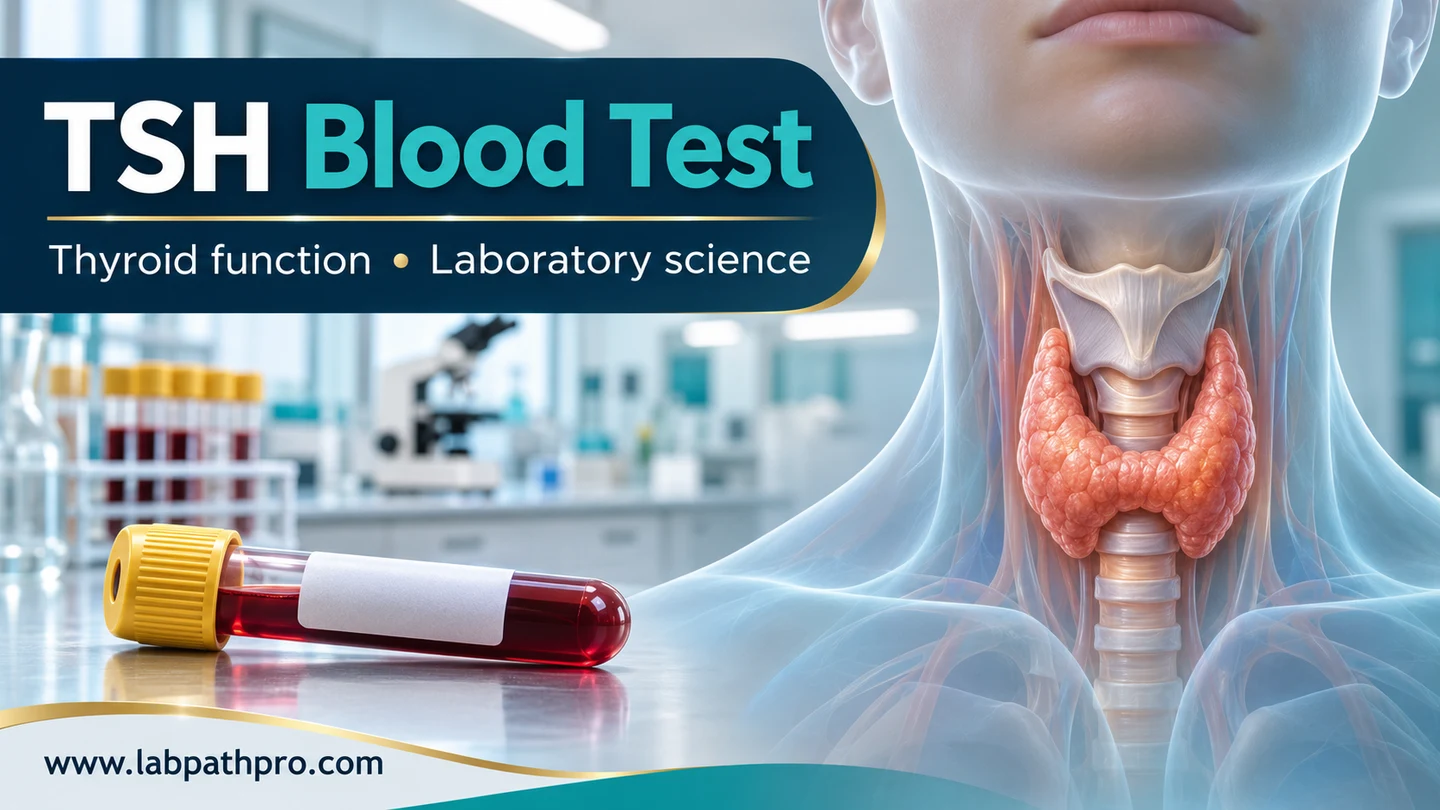
The thyroid is a butterfly-shaped endocrine gland located in the anterior neck, with two lobes connected by an isthmus. Its functional units are follicles: spheres of epithelial cells surrounding a protein-rich material called colloid. The colloid contains thyroglobulin, a large glycoprotein that provides the framework for thyroid hormone synthesis and storage.
The gland produces thyroxine (T4) and triiodothyronine (T3). These hormones influence energy expenditure, heat production, cardiovascular function, gastrointestinal motility, growth and neurological development. They modify gene expression through nuclear thyroid hormone receptors, influencing the production of proteins involved in metabolism. T3 is the more biologically active hormone, whereas T4 provides a circulating reservoir from which T3 can be generated.
Thyroid hormones affect multiple organ systems, explaining why thyroid disorders can produce apparently unrelated symptoms. Reduced activity can be associated with fatigue, constipation and cold intolerance, while excess activity may cause tremor, palpitations and heat intolerance. These symptoms are not specific to thyroid disease, making laboratory investigation an important component of assessment. 2
What is thyroid-stimulating hormone?
TSH, also known as thyrotropin, is a glycoprotein hormone secreted by thyrotroph cells of the anterior pituitary gland. It consists of two associated subunits, alpha and beta. The alpha subunit is shared with other glycoprotein hormones, including luteinising hormone, follicle-stimulating hormone and human chorionic gonadotrophin. The beta subunit contributes to the specificity of TSH receptor recognition.
The TSH receptor is a G protein-coupled receptor on thyroid follicular cells. Binding of TSH activates intracellular signalling, particularly the cyclic adenosine monophosphate (cAMP) pathway. This promotes iodide uptake, thyroid hormone synthesis and release, and supports the growth and function of thyroid tissue. Prolonged stimulation can contribute to enlargement of the gland, known as goitre. 2
The hypothalamic–pituitary–thyroid axis
The hypothalamus releases thyrotropin-releasing hormone (TRH), which reaches the anterior pituitary through the hypophyseal portal circulation. TRH stimulates secretion of TSH. Circulating TSH then acts on the thyroid to promote production of T4 and T3.
The system operates through negative feedback. When circulating thyroid hormone availability increases, feedback at the pituitary and hypothalamus reduces TSH and TRH secretion. When thyroid hormone availability decreases, an intact regulatory axis responds by increasing TSH secretion. This relationship is highly sensitive and is approximately log-linear over relevant physiological ranges, although individual set points vary.
TSH is also released in pulses and exhibits circadian variation, generally rising overnight and falling during the daytime. Sleep, illness and medications can modify this pattern. A single measurement is therefore a snapshot of a dynamic endocrine system rather than an absolute measure of thyroid activity. 2
How thyroid hormones are synthesised
Iodide obtained from the diet is transported into follicular cells by the sodium–iodide symporter. At the apical surface, thyroid peroxidase (TPO) catalyses oxidation and incorporation of iodine into tyrosine residues on thyroglobulin, a process called organification. This produces monoiodotyrosine (MIT) and diiodotyrosine (DIT). Coupling of iodinated residues produces T3 and T4 within thyroglobulin.
Following stimulation, follicular cells take up colloid and degrade thyroglobulin in lysosomes, releasing thyroid hormones into the circulation. Most secreted hormone is T4. Deiodinase enzymes in peripheral tissues convert T4 into active T3 or inactive metabolites, including reverse T3. The balance of these pathways changes during illness and development.
Most circulating T4 and T3 are reversibly bound to transport proteins, principally thyroxine-binding globulin, transthyretin and albumin. Only a small fraction is unbound. Free T4 (FT4) and free T3 (FT3) measurements are intended to assess this fraction, whereas total hormone measurements include both bound and unbound hormone. Changes in binding proteins can alter total hormone results without corresponding changes in thyroid function. 2
Why TSH is requested
TSH is commonly used to investigate suspected primary thyroid dysfunction and to monitor thyroid hormone replacement. It may form part of investigations for unexplained fatigue, weight change, menstrual disturbance, palpitations or other clinical features. It is also relevant to follow-up after treatment of thyroid disease.
In adults with suspected primary thyroid dysfunction, a TSH-first strategy can guide additional testing. A raised TSH prompts FT4 measurement; a reduced TSH prompts FT4 and FT3 measurement. Where pituitary disease is suspected, or in children and young people, initial testing includes both TSH and FT4. This is because TSH alone may not reveal central thyroid dysfunction. NICE NG145 describes these pathways.
Routine thyroid testing during acute illness is generally avoided unless thyroid dysfunction is suspected to contribute to the illness. Pregnancy, neonatal screening and thyroid cancer follow-up require their own clinical pathways. 1
High TSH: primary hypothyroidism
Primary hypothyroidism occurs when the thyroid gland is unable to supply sufficient thyroid hormone. The pituitary responds to reduced negative feedback by increasing TSH. Overt primary hypothyroidism typically produces a raised TSH and low FT4.
Autoimmune thyroiditis (Hashimoto’s thyroiditis) is a common cause. Immune-mediated damage gradually reduces the functional capacity of the gland. Thyroid peroxidase antibodies can support an autoimmune aetiology, although antibody positivity alone does not establish thyroid dysfunction. Other causes include thyroid surgery, radioiodine treatment, iodine imbalance and certain medicines.
The metabolic consequences may include reduced energy expenditure, altered lipid metabolism, slower gastrointestinal motility and changes in cardiovascular function. Symptoms and biochemical abnormalities vary in severity. The laboratory pattern helps distinguish primary gland failure from disorders elsewhere in the regulatory axis. 2
Low TSH: hyperthyroidism and thyrotoxicosis
Hyperthyroidism means increased thyroid hormone synthesis and secretion by the gland. Thyrotoxicosis describes the clinical state associated with excessive thyroid hormone action, irrespective of the source. The distinction is important: thyroiditis may release stored hormone without increased synthesis, while excessive exogenous thyroid hormone can also cause thyrotoxicosis.
In Graves’ disease, stimulating antibodies activate the TSH receptor, driving hormone synthesis despite suppression of pituitary TSH. Other causes of hyperthyroidism include toxic nodules and toxic multinodular goitre. TSH receptor antibody testing can help establish Graves’ disease in the appropriate setting.
A suppressed TSH with elevated FT4 and/or FT3 is compatible with primary thyrotoxicosis. Some patients have raised FT3 despite FT4 remaining within its reference interval, a pattern sometimes termed T3 thyrotoxicosis. A low TSH alone, however, cannot establish the cause. 2
Subclinical thyroid dysfunction
Subclinical hypothyroidism describes raised TSH with FT4 within its reference interval. Subclinical hyperthyroidism describes low TSH with FT4 and FT3 within their intervals. These are biochemical definitions, not statements about whether a patient has symptoms.
Transient abnormalities can occur during recovery from illness, following medication changes or because of analytical interference. Persistence, degree of abnormality, age, symptoms, comorbidity and pregnancy status affect clinical decisions. NICE uses a persistent TSH of at least 10 mIU/L on two occasions three months apart as one threshold for considering levothyroxine in adults with subclinical hypothyroidism; this is a clinical decision threshold, not a universal reference limit. Decisions below this level depend on individual circumstances. 1
Central hypothyroidism: when TSH can be misleading
Hypothalamic or pituitary disease can impair the production or biological activity of TSH. FT4 may be low while measured TSH is low, within its reference interval or occasionally mildly raised. In this setting a normal TSH is inappropriate for the low FT4 concentration. Assessment of other pituitary hormones and specialist clinical evaluation may be needed. TSH alone is not a reliable monitoring marker for established central hypothyroidism. 2
Interpreting thyroid function patterns
| TSH | FT4 | FT3 | Possible interpretation |
|---|---|---|---|
| Raised | Low | Variable | Primary hypothyroidism |
| Raised | Within interval | Usually within interval | Subclinical hypothyroidism |
| Low | High | High or within interval | Primary thyrotoxicosis |
| Low | Within interval | High | T3 thyrotoxicosis |
| Low | Within interval | Within interval | Possible subclinical hyperthyroidism |
| Low or inappropriately normal | Low | Variable | Possible central hypothyroidism or non-thyroidal illness |
| Not suppressed | High | Variable | Investigate discordance, including assay interference and uncommon regulatory disorders |
These patterns guide investigation rather than establish diagnoses in isolation. Adult TSH reference intervals differ between laboratories and assays; a single numerical range should not be treated as universal. Age, pregnancy, analytical method and population influence interpretation. Use the interval printed on the laboratory report. 2
From blood collection to laboratory result
TSH is usually measured in serum or validated plasma. The collection tube must be compatible with the analytical method. Serum requires adequate clot formation before centrifugation; plasma requires an appropriate anticoagulant. Correct identification, transport, sample separation and storage protect result integrity. Residual fibrin, cellular material and sample contamination may affect analysis. Fasting is not generally necessary for TSH alone, although accompanying investigations may have separate requirements.
In an automated laboratory, the specimen is registered, prepared and routed to an immunoassay analyser. The laboratory information system associates results with the correct patient and request. Instrument flags, quality control status, relevant previous results and local reporting rules inform technical validation before release. 2
How TSH is measured: the sandwich immunoassay
Most routine TSH assays use a two-site immunometric format. Unlike a small molecule that may provide only one accessible binding site, TSH can be recognised by two antibodies targeting different epitopes. A capture antibody binds the hormone; a second, labelled antibody binds to another accessible site, producing a sandwich complex.
A solid phase such as magnetic microparticles or a coated well enables separation of bound complexes from excess reagents. Depending on the technology, the detection label may generate light through a chemical reaction, an electrically initiated reaction, or an enzyme-mediated colour or light reaction. Common methods include chemiluminescent immunoassay (CLIA), chemiluminescent microparticle immunoassay (CMIA), electrochemiluminescence immunoassay (ECLIA) and enzyme-linked immunosorbent assay (ELISA).
Within the validated measurement interval, the signal generally increases with TSH concentration. Calibration establishes the relationship between measured signal and assigned concentrations. Mathematical curve fitting translates the signal into a reported result in mIU/L. Assay architecture, antibody selection and calibration can differ between platforms, so measurements are not necessarily interchangeable.
The limit of blank describes background signal, the limit of detection describes the smallest reliably detectable amount, and the limit of quantitation describes the lowest amount measurable with specified performance. These distinctions matter particularly when assessing very low TSH concentrations. A result below the quantitation limit is not equivalent to zero. 2
Analytical interference: when the result does not fit
Immunoassays are highly useful but can occasionally produce misleading results. Heterophile antibodies and human anti-animal antibodies may bind assay antibodies, either generating a signal in the absence of the intended analyte or inhibiting complex formation. The result may be falsely high or low.
Macro-TSH is a high-molecular-weight complex, commonly involving TSH bound to immunoglobulin. It may persist in circulation and be detected by immunoassays despite limited biological activity. An unexplained persistent TSH elevation with normal FT4 may warrant consideration of this possibility.
High-dose biotin can disrupt assays that use streptavidin–biotin binding. Depending on the architecture, it may produce falsely low TSH and falsely high free thyroid hormone measurements, mimicking hyperthyroidism. Not all platforms are susceptible. Other reagent-directed antibodies and thyroid hormone autoantibodies can also interfere with particular assays.
A very high analyte concentration may cause a high-dose hook effect in susceptible sandwich methods, generating an unexpectedly low signal. Its relevance depends on assay design and the concentration involved. Investigation may include an alternative method, validated dilution studies, blocking reagents or polyethylene glycol precipitation for suspected macro-TSH. No single investigation excludes every interference. The laboratory and clinical team should collaborate when results and clinical findings disagree. 3,4
Monitoring treatment
TSH is an important marker for monitoring primary hypothyroidism treated with levothyroxine. Its response can lag behind changes in circulating hormone, so premature repeat testing may be misleading. During initial treatment of hyperthyroidism, TSH may remain suppressed after FT4 and FT3 improve. Monitoring should follow the clinical pathway and use the appropriate combination of tests. Consistency of sampling and analytical methods helps interpret trends over time. 1
The role of the Biomedical Scientist
Reliable thyroid results require control of the entire testing process. Biomedical Scientists assess specimen suitability, verify method performance, monitor calibration and internal quality control, participate in external quality assessment and investigate unexpected results. Method verification includes precision, bias, measurement interval and relevant interference characteristics. Quality control assesses ongoing performance, while external quality assessment provides comparison with other laboratories.
A technically plausible result can still be clinically misleading. Recognising an inconsistent pattern, escalating concerns and communicating effectively with clinical colleagues are important contributions to patient safety. Automated validation rules support these decisions but do not replace professional judgement. 2
Frequently asked questions
Does TSH measure thyroid hormone directly? No. It measures a pituitary hormone that regulates thyroid hormone production.
Is a normal TSH always reassuring? It is often useful in primary thyroid disease, but cannot exclude central hypothyroidism or all other thyroid-related disorders.
Can an abnormal TSH return to normal? Yes. Transient illness, physiological variation, medication effects and other factors can cause temporary abnormalities.
Is TSH a test for thyroid cancer? No. It assesses thyroid regulation and is not a general diagnostic marker for thyroid cancer. 2
Conclusion
TSH connects endocrine physiology with laboratory diagnostics. Its sensitivity to feedback makes it valuable for detecting primary thyroid dysfunction, while its limitations demonstrate why laboratory results must be interpreted in context. Understanding hormone synthesis, immunoassay design and quality assurance enables biomedical science professionals to contribute to accurate diagnosis and safe patient management. 2
Key learning points
- TSH is produced by the anterior pituitary and helps regulate thyroid hormone production.
- Interpret TSH alongside FT4, sometimes FT3, the clinical picture and the laboratory’s reference intervals.
- A normal TSH does not exclude central hypothyroidism.
- Unexpected patterns should prompt clinical–laboratory discussion, including consideration of assay interference.
References and further reading
- National Institute for Health and Care Excellence. Thyroid disease: assessment and management. NG145. Read source. Accessed 27 November 2026.
- Van Uytfanghe K, Ehrenkranz J, Halsall D, et al. Thyroid Stimulating Hormone and Thyroid Hormones (Triiodothyronine and Thyroxine): An American Thyroid Association-Commissioned Review of Current Clinical and Laboratory Status. Thyroid. 2023. Read source. Accessed 27 November 2026.
- Campi I, et al. 2026 ETA guideline on interference in immunoassay measurements used in assessment of thyroid function. Eur Thyroid J. 2026. Read source. Accessed 27 November 2026.
- Favresse J, et al. Interferences With Thyroid Function Immunoassays: Clinical Implications and Detection Algorithm. Endocr Rev. 2018. Read source. Accessed 27 November 2026.
Continue learning
Explore the Clinical Chemistry collection and the Learning Centre for further laboratory education.
LabPathPro provides educational resources for biomedical science and healthcare professionals. This information is intended for learning and professional development and does not replace clinical judgement, local laboratory procedures, manufacturer instructions or current clinical guidelines. Reference intervals, analytical methods and reporting practices may vary between laboratories.