
IBMS Registration Portfolio Section 1
From Sample to Result: Patient Records, Confidentiality and Data Integrity in Clinical Chemistry
Follow the Clinical Chemistry sample-and-data pathway and learn how biomedical scientists protect identity, confidentiality, consent, records, LIMS data and backups.
The result is only as trustworthy as its identity and record
A perfectly measured glucose result is unsafe if it is attached to the wrong patient. A correct critical-result call is difficult to defend if it was not recorded. A sample photograph used in a portfolio can breach confidentiality even when the patient’s name is not visible. A LIMS backup is of little value if the laboratory cannot restore and reconcile it.
Records and data handling are therefore scientific and professional competencies, not office administration. They preserve the link between the service user, request, specimen, analysis, result and clinical action.
This article follows the IBMS Registration Training Portfolio module on Patient Records and Data Handling. It connects professional standards with the scientific sample pathway taught across clinical laboratory science, analytical science, physiology, research and professional-development modules.
Learning outcomes
Knowledge: what you should understand
After reading this article, you should be able to explain:
- how consent, confidentiality and information governance apply to the pathology pathway;
- why consent for care and the lawful basis for processing information are related but not identical questions;
- the data-protection and Caldicott principles relevant to laboratory work;
- what makes a laboratory record full, clear, accurate, timely and traceable;
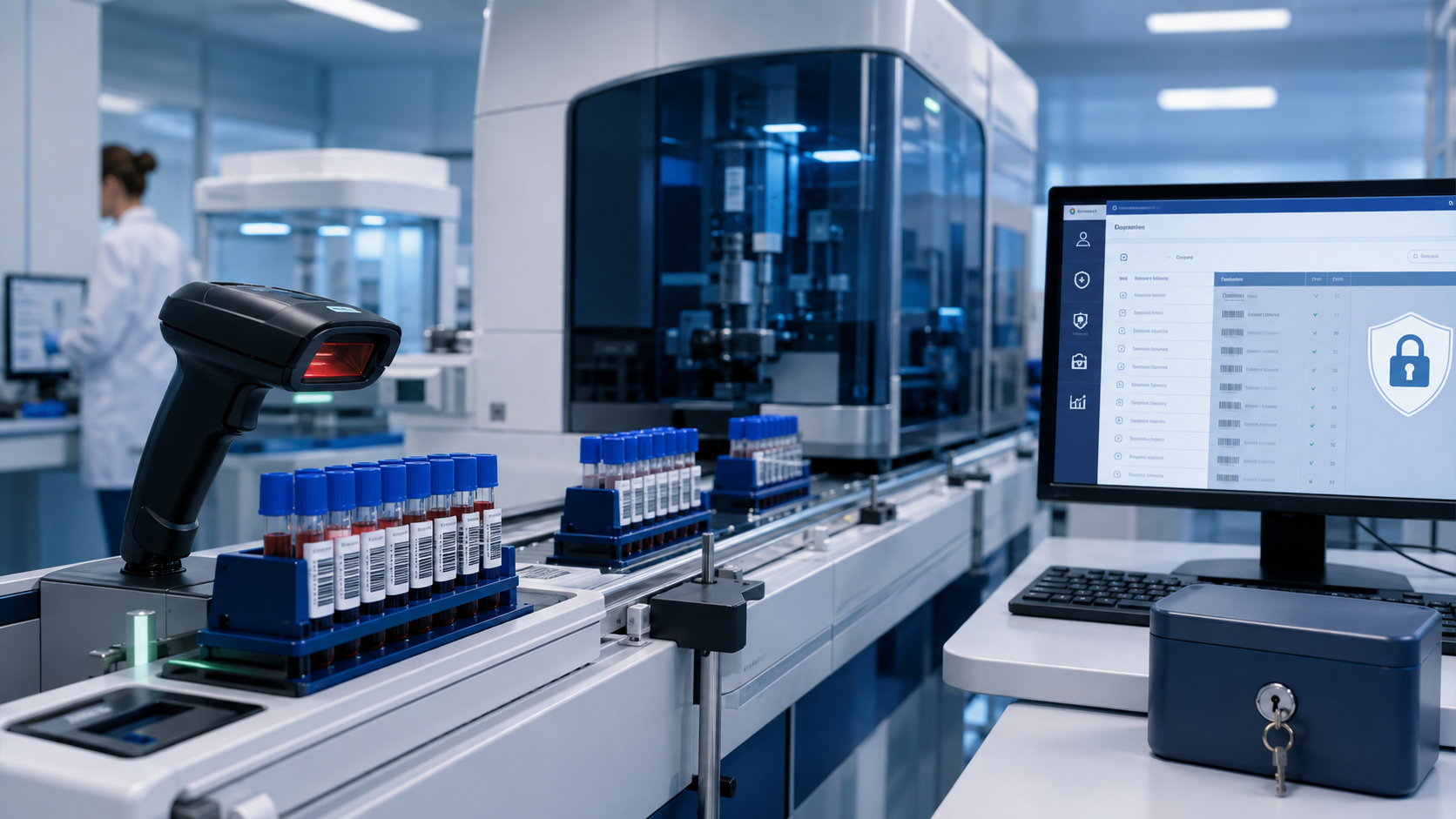
- how specimen identification, barcodes, interfaces and audit trails protect patient identity;
- how pre-analytical errors can affect the validity and interpretation of results;
- why photographs, audio, video, screenshots and digital platforms require the same care as other records; and
- what backup, recovery, downtime and reconciliation mean in practice.
Competence: what you should be able to demonstrate in practice
With supervised local training and assessment, you should be able to:
- use the LIMS and other digital systems through your own authorised account;
- confirm that request and specimen identifiers meet the local acceptance policy;
- recognise and escalate an identification or data-quality discrepancy;
- enter, verify, amend and annotate records using approved processes and an audit trail;
- protect information when communicating, printing, photographing or preparing portfolio evidence;
- follow downtime and recovery procedures;
- share necessary information safely where care or safeguarding requires it; and
- explain the complete specimen-and-data pathway for one Clinical Chemistry test.
1. One pathway, two linked objects
Every pathology investigation has:
- a physical pathway for the specimen; and
- an information pathway for the patient, request, processing history, result and communication.
The two must stay correctly linked. A typical Clinical Chemistry pathway is:
- a clinician decides that an investigation is needed;
- the request is created with patient and clinical details;
- the patient is identified and the specimen is collected and labelled;
- the specimen is transported and received;
- reception checks identifiers, container, condition and request information;
- the specimen is accessioned and given a laboratory identifier or barcode;
- it is prepared, routed, analysed and linked to QC and analyser records;
- authorised staff review, validate and release results;
- urgent or unexpected findings are communicated and recorded;
- records and specimens are retained for defined periods; and
- information and material are securely archived, transferred or disposed of.
Patient identity, specimen identity and the digital record must stay linked at every handover.
At each step, ask two questions: “Is this the correct specimen for this person?” and “Can an authorised reviewer reconstruct what happened?”
2. Confidentiality is a professional duty
Confidential information includes more than a patient’s name. NHS number, date of birth, address, laboratory number, rare diagnosis, ward, test pattern, photograph, voice and contextual details may identify a person alone or in combination.
The duty of confidentiality means that you:
- access information only for a legitimate work purpose;
- use the minimum necessary information;
- share it only with an appropriate recipient through a secure route;
- prevent accidental viewing, hearing, copying or loss;
- follow retention and disposal rules; and
- understand that disclosure may sometimes be required or justified, for example for direct care, a safeguarding need or a legal duty.
Confidentiality is not absolute secrecy. It supports safe and trusted information sharing. The Caldicott Principles include both a duty to protect confidential information and a duty to share it for individual care when that sharing is appropriate. If uncertain, seek advice from the laboratory manager, information-governance team, Caldicott Guardian or safeguarding lead as applicable.
3. Consent and information governance are not the same question
Consent matters in at least two ways:
- Consent to examination, treatment or specimen collection. This concerns the person’s agreement to care and requires voluntariness, information and capacity.
- The legal and professional basis for using patient information. UK data-protection law and the common-law duty of confidentiality govern how information is processed and shared. Consent is not the only possible lawful basis for healthcare processing.
Routine pathology testing is usually part of direct care. Implied consent may support necessary information sharing within the care team when the person has been informed and has not objected, provided the use is reasonable and expected. Different purposes—such as research, publication, marketing or some teaching uses—may require a different approval, legal basis or explicit consent.
A biomedical scientist should not invent the governance basis. If a sample is proposed for a new purpose, such as a research project, method-development bank, presentation or public image, check the approved protocol and seek governance advice.
4. The current UK data-protection framework
Health information is highly sensitive personal data. The UK GDPR and Data Protection Act 2018 remain central, and the Data (Use and Access) Act 2025 has amended parts of that framework rather than replacing it. Your organisation’s current policies translate these duties into operational requirements.
Useful data-protection principles are:
- lawfulness, fairness and transparency: use data through a recognised basis and do not surprise people;
- purpose limitation: use information for the defined legitimate purpose;
- data minimisation: use only what is needed;
- accuracy: correct errors and keep information fit for purpose;
- storage limitation: keep information for no longer than the approved retention period;
- integrity and confidentiality: protect against unauthorised access, loss or damage; and
- accountability: be able to show that controls are in place and followed.
Do not try to make independent legal interpretations at the bench. Know your responsibilities, use the approved system and ask the information-governance team when a situation falls outside routine practice.
5. What makes a good laboratory record?
A reliable record is:
- attributable: it shows who made the entry or decision;
- legible and clear: another authorised person can understand it;
- contemporaneous: it is made at the time or as soon as possible;
- accurate: identifiers, numbers, units, dates and times are checked;
- complete: it includes material facts, action, outcome and escalation;
- traceable: changes preserve the original information and reason;
- secure: access and storage are controlled; and
- retrievable: it can be found for care, audit, investigation or legal need.
“The result was checked” is usually inadequate. A useful record may need to say what was checked, the finding, who was consulted, the decision and the time.
Correcting a record
Never hide an error by deleting or overwriting information outside the approved amendment process. Electronic systems should preserve an audit trail. Paper corrections should follow local rules, often a single line through the original entry, dated and attributable, without obscuring it. State the reason for a material result amendment and complete any required clinical notification or incident report.
6. Patient and specimen identification
Specimen identification is a chain of controls, not a single barcode scan. It begins with identifying the person at collection and continues through every transfer, aliquot and analyser interface.
Local policy defines the minimum identifiers and how exceptions are handled. Common identifiers include full name, date of birth and NHS or hospital number, but requirements vary by setting and urgency. Never “repair” a mismatch by guessing.
Barcode controls
Barcodes reduce manual transcription, but they do not prove that the correct label was placed on the correct tube. Risks include:
- label printed for the wrong patient;
- several labels at a bedside or collection station;
- label placed over important tube information;
- duplicate or damaged barcode;
- aliquot label attached to the wrong secondary tube;
- scanner reading a nearby code; and
- interface mapping a result to the wrong test or specimen.
Use positive identification, one-patient-at-a-time collection practice, visual checks, scanner prompts and local acceptance criteria. Automation supports human checks; it does not replace them.
7. Daily practice example: the urgent mislabelled sample
An urgent electrolyte specimen arrives from an acute ward. The tube shows one surname, while the electronic request shows another. A nurse telephones and says that the tube belongs to the patient on the request and asks you to change the label.
Why this is high risk
You cannot establish specimen identity retrospectively from confidence or urgency. Relabelling could attach a result to the wrong person. Rejection may delay care, so the situation also needs prompt escalation.
Competent response
- Do not alter the specimen label or electronic demographics outside policy.
- Stop processing or hold results as the SOP requires.
- Record the discrepancy accurately.
- Explain the patient-safety reason without blaming the caller.
- Escalate through the urgent, irreplaceable or inadequately labelled specimen pathway.
- Request a correctly identified repeat where appropriate.
- If an authorised exception process exists for a genuinely irreplaceable sample, ensure the correct senior and clinical decisions, declarations and report comments are recorded.
- Complete the non-conformance or incident process where required.
The laboratory should review patterns of labelling error and work with clinical areas on system improvement. Rejecting one tube is a control; preventing recurrence is quality improvement.
8. Pre-analytical data are part of result validity
The laboratory record must contain enough information to judge sample suitability. Important variables can include:
- specimen type and container;
- collection date and time;
- receipt and separation time;
- fasting, posture or timed-test status where relevant;
- transport temperature or delay;
- fill volume and anticoagulant ratio;
- haemolysis, icterus and lipaemia;
- contamination risk;
- clinical details and medicines where needed for interpretation; and
- collection sequence for tests affected by additive carryover.
Chemistry examples
- Delayed separation can change some analytes because cells continue to metabolise or release substances.
- Haemolysis may raise or interfere with several measurements and can mask or mimic a clinical change.
- EDTA contamination may produce a pattern including raised potassium and reduced calcium; interpretation follows local policy.
- A short-filled citrate tube is mainly a coagulation issue, but it illustrates why container-to-additive ratio matters across pathology.
- A mistimed dynamic-function sample may be analytically correct but clinically uninterpretable.
Record the factual pre-analytical problem and use an authorised comment. Do not add speculation as if it were proven.
9. Safe LIMS practice
The LIMS is a clinical record and a quality system. Use it deliberately.
Access
- Use your own account and only permissions appropriate to your role.
- Never share passwords or approve work under another person’s login.
- Lock the screen when leaving it.
- Do not search for yourself, relatives, colleagues or public figures unless authorised for a genuine work purpose.
Entry and validation
- Select the patient using required identifiers, not bed or location alone.
- Check decimal points, units and test codes during manual entry.
- Distinguish final, provisional, corrected and cancelled results.
- Use approved comments and ensure they apply to the current specimen.
- Confirm that analyser and middleware flags transferred correctly.
- Do not validate outside your competency or authorisation.
Audit trail
An audit trail should show important entries, amendments, releases and users. Do not treat it as a reason to be careless. It helps reconstruct events, but accurate contemporaneous documentation is still required.
10. Photographs, video, audio and portfolio evidence
Confidentiality and consent apply across all media. A photograph of a tube rack may show a barcode. A screenshot may reveal a patient name in a browser tab. A video of an analyser may capture a request list. An audio recording may identify a caller by voice and context.
Before creating or using any image or recording:
- confirm that the purpose is approved;
- use the organisation’s device and secure storage if required;
- obtain the correct consent or governance approval;
- remove all direct and indirect identifiers;
- check reflections, screens, labels, whiteboards and background conversations;
- limit access and retention; and
- follow the training portfolio and employer rules.
Cropping a name after copying an image to a personal phone does not undo the original breach. The safest evidence is often a purpose-made diagram or simulated sample rather than a clinical image.
11. Confidentiality with interpreters and supporters
Additional communication support does not reduce the duty of confidentiality. Confirm the interpreter or supporter’s role, use an approved service where required and share only what is necessary.
Speak to the service user rather than the interpreter. Check whether the person is comfortable with a supporter being present, unless a legal or urgent safeguarding situation requires a different approach. Record relevant communication needs through the approved system without adding judgemental labels.
13. Downtime, backup and recovery
A backup is a protected copy that can support recovery after loss, corruption, cyberattack or system failure. Safe practice requires more than knowing that “IT backs it up”. Laboratories need controlled arrangements for:
- backup frequency and scope;
- secure and appropriately separated storage;
- access control and monitoring;
- restoration testing;
- LIMS, middleware, analyser and document-system dependencies;
- paper or offline downtime records;
- unique identification during downtime;
- manual result communication and authorisation;
- reconciliation when systems return; and
- investigation of missing, duplicated or misrouted data.
Trainees should know their operational role. During downtime, do not create a personal spreadsheet or messaging route unless it is part of the approved plan.
Daily practice example: the interface returns
During a two-hour interface failure, authorised staff record results on controlled downtime worksheets and communicate urgent results by the approved route. When the interface is restored, patient results begin to transmit.
The job is not finished. The team must reconcile every downtime accession: confirm whether results have transferred once, identify manual entries, avoid duplicate release, preserve communication records and resolve discrepancies. The shift handover must state what remains unreconciled and who owns it.
14. Retention and disposal
Different records and materials have different retention periods. Request information, reports, QC data, maintenance records, raw instrument data, incident files and specimens may not be retained for the same length of time. Use the NHS Records Management Code, professional guidance, accreditation needs and the organisation’s approved schedule.
Dispose of paper, labels, media and electronic equipment securely. Human specimens must follow authorised retention and disposal procedures, including health-and-safety and human-tissue governance. Do not keep copies “just in case”.
15. What competent practice looks like
A competent trainee or biomedical scientist:
- keeps the specimen and digital record correctly linked;
- checks minimum identifiers and does not guess or retrospectively relabel outside policy;
- creates attributable, accurate and timely records;
- uses only authorised accounts and systems;
- understands why pre-analytical data affect result validity;
- preserves audit trails and corrects errors transparently;
- protects information in speech, print, screens, images and recordings;
- shares necessary information appropriately rather than either oversharing or obstructing care;
- follows downtime and reconciliation procedures; and
- can explain local backup, retention, disclosure and incident routes.
16. Common mistakes and better alternatives
| Common mistake | Better professional practice |
|---|---|
| Treating the barcode as proof of identity | Combine barcode technology with positive identification and visual checks. |
| Changing a mismatched record to fit the tube | Stop and use the discrepancy or exception pathway. |
| Sharing a login during a busy shift | Use individual authorised access and escalate access problems. |
| Copying an old LIMS comment without review | Confirm that every comment is accurate for the current specimen. |
| Keeping a patient-data screenshot for a portfolio | Use a simulated or fully governed, anonymised alternative. |
| Refusing all information sharing “because of GDPR” | Share necessary information through an appropriate lawful and secure route. |
| Assuming a backup is effective because it exists | Understand recovery testing, downtime and reconciliation responsibilities. |
| Recording an incident from memory at the end of the week | Make a contemporaneous factual record as soon as possible. |
17. HCPC Standards of Proficiency covered
The following standards are mapped to the IBMS Patient Records and Data Handling module. The wording is summarised in plain English; use the current HCPC publication for the authoritative wording.
| HCPC SoP | What it means in Clinical Chemistry practice |
|---|---|
| 6.1 | Maintain professional confidentiality and understand when disclosure may be needed. |
| 6.2 | Understand information and data governance and use health and care information safely and effectively. |
| 6.3 | Share information promptly where necessary to safeguard service users, carers or the public. |
| 6.4 | Maintain confidentiality when interpreters, translators or other communication support are used. |
| 6.5 | Apply confidentiality and informed-consent principles to photographs, video, audio, records and digital platforms. |
| 9.1 | Keep full, clear and accurate records in line with law, protocols and guidance. |
| 9.2 | Manage records and other information in line with law, protocols and guidance. |
| 9.3 | Use digital record-keeping tools where required. |
| 9.4 | Recognise, communicate and understand the potentially serious consequences of errors or omissions in requests and results. |
| 9.5 | Use systems that accurately identify service users and laboratory specimens. |
| 9.6 | Follow specimen-identification protocols, including barcodes and electronic tags. |
| 9.7 | Understand why electronic data require backup storage. |
18. Portfolio and supervision prompts
Use simulated or fully anonymised information and agree evidence with your training officer.
- Draw the physical and digital pathway for one Clinical Chemistry specimen from request to disposal. Where can identity be lost?
- Observe specimen reception. Which criteria cause acceptance, rejection or escalation?
- Ask for a direct observation of your LIMS practice. Can another person reconstruct your actions from the audit trail?
- Review one pre-analytical error and explain the possible effect on result validity and patient care.
- Locate the downtime procedure. How are unique identity, critical calls and reconciliation controlled?
- Explain how your laboratory handles images or screenshots for training evidence.
- Who provides information-governance, Caldicott and safeguarding advice locally?
Key takeaways
- Specimen identity and data integrity are inseparable from analytical quality.
- Consent to care and the legal basis for processing information are not identical concepts.
- Confidentiality supports appropriate care; it does not prohibit necessary, proportionate sharing.
- Good records are attributable, clear, accurate, timely, traceable, secure and retrievable.
- Barcodes reduce error but do not replace positive identification.
- Backup must include tested recovery, controlled downtime and complete reconciliation.
Suggested references
- Health and Care Professions Council. Standards of proficiency: Biomedical scientists (effective 1 September 2023)
- Health and Care Professions Council. Standards of conduct, performance and ethics (effective 1 September 2024)
- Institute of Biomedical Science. Registration Training Portfolio V5: Module Descriptors, version 1.1, May 2025
- NHS England. Consent to using and sharing patient information
- NHS England Transformation Directorate. Records Management Code of Practice
- UK Government. The Caldicott Principles
- UK Government. Data Protection Act 2018
- UK Government. Data (Use and Access) Act 2025
- Information Commissioner’s Office. Data (Use and Access) Act 2025
- Human Tissue Authority. Codes of practice, standards and legislation
- Institute of Biomedical Science. Good Professional Practice in Biomedical Science, updated 2025