
Articulation Training for Biomedical Scientists: Improve Communication, NHS Job Applications and Interview Skills

Professional development | Communication skills | NHS careers | Biomedical Science
Biomedical Scientists develop extensive scientific knowledge through university education, laboratory training and daily practice. Yet knowing the correct answer and communicating it effectively are not always the same thing. You may understand internal quality control (IQC), haemolysis or the causes of an analyser fault, but find it difficult to explain your reasoning during a meeting or NHS job interview.
Articulation training can help you organise your thoughts, speak clearly and present genuine evidence of your skills and experience. For trainees, it is particularly relevant to competency discussions and interviews for a first registered Biomedical Scientist post. For experienced staff, it can strengthen communication in handovers, teaching, supervision, problem-solving and career progression.
This guide explains what articulation training means in a professional context, how it relates to Health and Care Professions Council (HCPC) expectations, and how to practise it using realistic NHS pathology scenarios.
Key message: Effective articulation is not about changing your accent, using complicated vocabulary or sounding rehearsed. It is about communicating accurate information in a clear, respectful and purposeful way.
What is articulation training?
In speech, articulation refers to how clearly sounds and words are produced. In professional development, people sometimes use the broader expression articulation training for practising how to organise ideas and communicate them effectively. This broader use is not a separate HCPC qualification or an officially required NHS training course.
For laboratory professionals, the goal is to develop two related skills:
- Clear speech: Using a suitable pace, volume, pronunciation, pauses and emphasis so that others can follow what you are saying.
- Clear thinking and expression: Selecting relevant information, arranging it logically and explaining the main message without unnecessary detail.
The aim is not to eliminate a regional or international accent. People communicate effectively using many accents and communication styles. What matters is whether information is accurate, accessible and understood.
A simple example: describing your experience
Less effective:
“I do chemistry, QC, maintenance and results. I help with problems and sometimes train people.”
Clearer and more specific:
“I have experience working in a clinical chemistry laboratory, including internal quality control, routine analyser maintenance and following procedures for investigating analytical problems. I also support colleagues with laboratory processes and escalate issues when they fall outside my competence.”
The second response makes the responsibilities easier to understand. It does not invent qualifications or responsibilities; applicants should only use wording that accurately reflects their own experience.
Why communication matters in Biomedical Science
Biomedical Scientists work with complex information that must be interpreted, recorded and communicated appropriately. A laboratory professional may need to discuss an IQC failure with a senior colleague, explain a sample rejection to a clinical team, describe a troubleshooting investigation during a handover or teach a trainee how to follow a standard operating procedure (SOP).
Poorly structured communication can create confusion, delay appropriate action or make it harder for colleagues to understand what has been checked and what still needs to happen. Clear communication supports teamwork, quality assurance and patient safety. It also helps employers assess a candidate’s skills more fairly when these are described with relevant evidence.
What do the HCPC standards say?
The HCPC Standards of Proficiency for Biomedical Scientists, effective from 1 September 2023, include several directly relevant requirements:
- 7.1: Use effective and appropriate verbal and non-verbal communication.
- 7.3: Understand how verbal and non-verbal communication can be affected by individual and cultural differences.
- 7.5: Adapt communication to the individual needs and preferences of service users and carers, removing barriers where possible.
- 7.7: Use appropriate information, communication and digital technologies.
- 7.9: Communicate the outcomes of biomedical procedures.
- 8.4: Contribute effectively to multidisciplinary team working.
- 9.4: Recognise and communicate the risks and possible serious consequences of errors or omissions involving laboratory requests and results.
The HCPC Standards of Conduct, Performance and Ethics, effective from 1 September 2024, also require appropriate and effective communication, responsible information sharing and professional respect for colleagues.
These requirements concern safe professional practice; speaking confidently in an interview is not a substitute for clinical competence. For a trainee, communication should always reflect their actual level of training and supervision. Biomedical Scientist is a protected professional title that requires HCPC registration.
Five skills that improve articulation
1. Clarity: start with the important message
Before speaking, decide what the listener needs to know. Give the main point first, then the evidence or explanation.
Laboratory example: Instead of saying, “The analyser was doing strange things and I checked quite a few things”, say, “The analyser failed the potassium IQC acceptance criteria. I held the affected results and investigated according to the SOP.”
Try this: Explain an IQC failure in two sentences: one stating the issue and one describing the safe next step.
2. Structure: explain events in a logical order
A useful structure for technical explanations is issue → checks → action → outcome. The listener should be able to identify what happened, what you did and what changed.
Try this: Select a routine laboratory problem. Record a 45–60-second explanation using those four stages.
3. Pace and pauses: allow information to be understood
Speaking rapidly can make technical explanations difficult to follow, particularly when they contain unfamiliar abbreviations. Use a comfortable speaking pace, pause after important information and avoid filling every pause with words.
Try this: Record an answer to “What is the purpose of internal quality control?” Listen for phrases that are rushed, unclear or repeated. Record it again at a natural pace.
4. Appropriate language: match the listener’s needs
A fellow Biomedical Scientist may understand terms such as pre-analytical interference, calibration and IQC. A member of the public may benefit from a simpler explanation. Avoid jargon unless it helps the listener, and explain specialist terms when necessary.
5. Listening and checking understanding
Articulation is not only about speaking. Active listening, asking appropriate questions and confirming shared understanding are essential. In safety-critical communication, use the confirmation or read-back procedures required by your local SOP.
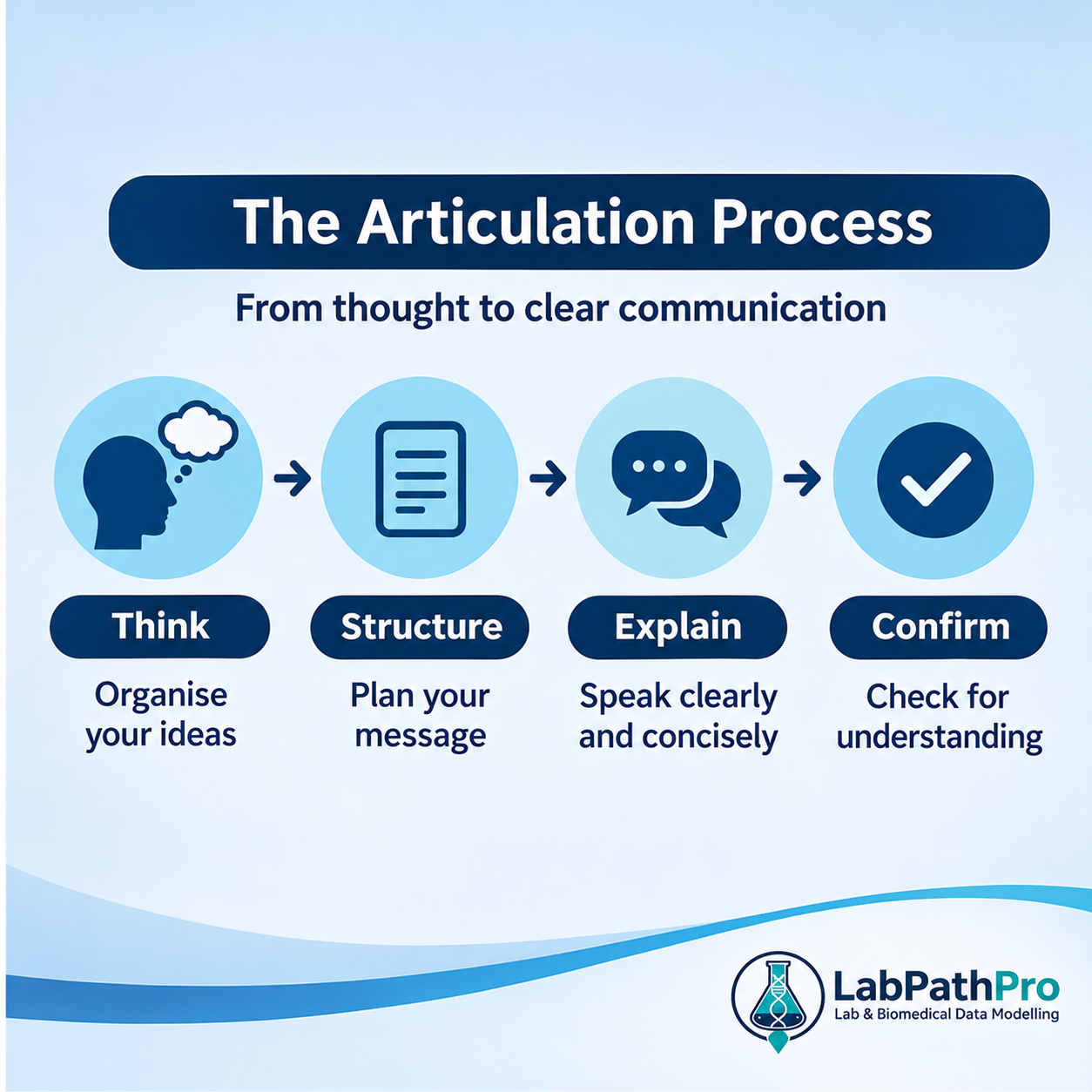
Articulation in everyday NHS laboratory practice
Example 1: Explaining an IQC failure
Unclear handover:
“The QC was wrong earlier, but I looked at it and I think it is fine now.”
Structured handover:
“The potassium IQC result was outside our acceptance criteria, so reporting for the affected assay was stopped. I followed the troubleshooting procedure, reviewed the relevant checks and documented the actions taken. Subsequent IQC met the acceptance criteria, and reporting resumed after the required checks and authorisation.”
This is an illustrative example, not a universal troubleshooting procedure. Actual actions must follow the analyser instructions, local SOP and the individual’s authorisation level.
Example 2: Explaining haemolysis to different audiences
To a Biomedical Science student: “Haemolysis is the disruption of red blood cells, releasing intracellular material into the serum or plasma. Depending on the analyte and analytical method, it can alter results or cause analytical interference.”
To a clinical colleague: “The specimen is haemolysed, which may affect certain measurements, including potassium. We will assess the interference against our laboratory criteria and advise if another specimen is required.”
To someone without laboratory training: “Some blood cells were damaged in the sample. This can affect certain test results, so another blood sample may be needed.”
The scientific principle stays the same. The language changes according to the listener’s knowledge and needs. The decision to reject, comment on or report a specimen follows local laboratory policies and method-specific interference limits.
Example 3: Teaching a trainee
When demonstrating a procedure, avoid giving a long sequence of instructions without checking understanding. Explain the purpose, demonstrate the key steps, invite questions and confirm what the trainee is authorised to perform independently. Ask the trainee to describe the procedure back in their own words, then provide constructive feedback.
This also creates opportunities to document training and reflection for an IBMS Registration Training Portfolio or departmental competency assessment, where relevant. Evidence should distinguish understanding of a process from demonstrated, supervised workplace competence.
Using articulation skills in NHS job applications
For an NHS application, good articulation starts before the interview. Your supporting information must show how your knowledge, behaviours and experience meet the requirements of the advertised role.
NHS employer guidance recommends working through the essential and desirable criteria in the person specification and giving specific examples. The NHS job application guide from North London Shared Services similarly advises applicants to use authentic evidence rather than invented or generic AI-generated claims.
Start with the person specification
For each essential criterion, ask yourself:
- What does the employer want to know? For example, experience of quality control, teamwork, IT systems or safe laboratory practice.
- What genuine evidence do I have? A relevant placement, observed competency, supervised task or previous job responsibility.
- What did I personally do? Avoid hiding your contribution behind vague statements about the team.
- What was the outcome or learning? Mention what happened, what improved or what you would do differently.
Application example: describing teamwork
Generic statement:
“I am a good team player with excellent communication skills.”
Evidence-based statement:
“During my supervised clinical chemistry placement, I supported sample reception and helped colleagues manage the routine workflow during busy periods. I communicated outstanding tasks at handover, checked when I was unsure and followed local escalation procedures for specimen queries. This helped me understand how accurate communication contributes to safe and timely laboratory work.”
The improved version is stronger because it gives the recruiter observable behaviour. Use it as a model for structure, not as text to copy unless it is true of your experience.
Write for the role you are applying for
A trainee seeking a first Band 5 Biomedical Scientist post might focus on HCPC registration status, supervised practical experience, recognition of professional limitations, patient safety, competence and willingness to learn. An experienced Band 5 applying for Band 6 may need more evidence of specialist practice, troubleshooting, training others, quality improvement, leadership and taking responsibility within their scope.
Read each advertisement carefully: NHS organisations and job grades can have different essential criteria, and job titles alone do not establish identical responsibilities.
Improving NHS interview answers with STAR
For behavioural questions such as “Tell us about a time you dealt with a laboratory problem”, the STAR method provides a useful structure:
- Situation: What was happening?
- Task: What were you responsible for?
- Action: What did you do, and why?
- Result: What happened, and what did you learn?
STAR is commonly recommended in NHS application and interview guidance. Spend the most time explaining your action and result; the introduction should provide only enough context for the panel to understand the situation.
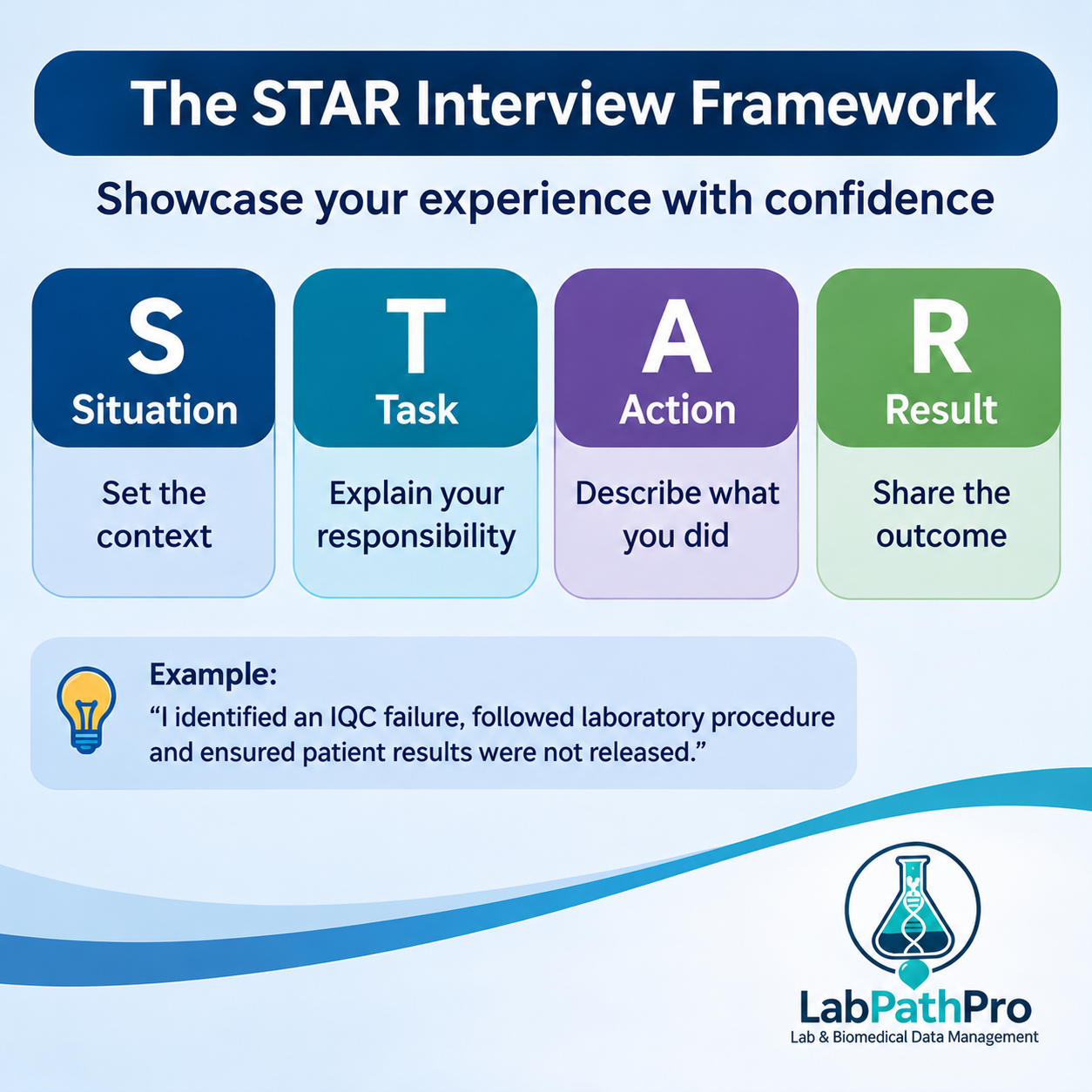
Worked interview example: dealing with an analytical problem
Interview question: “Describe a time you identified a problem in the laboratory and how you responded.”
Situation: “During a routine clinical chemistry shift, I noticed an internal quality control result outside the laboratory’s acceptance limits.”
Task: “My responsibility was to prevent inappropriate release of affected results and make sure the problem was investigated and escalated appropriately.”
Action: “I stopped the affected reporting process, reviewed the relevant IQC information, followed the documented troubleshooting steps and informed the senior Biomedical Scientist. I recorded the investigation and corrective actions in accordance with the local procedure.”
Result: “The issue was resolved and acceptable IQC performance was confirmed before reporting resumed through the authorised process. It reinforced the importance of recognising analytical risk, documenting actions and escalating promptly.”
This is a fictional educational example. Adapt the structure to an incident you actually experienced. Trainees must not claim to have performed unsupervised result authorisation or troubleshooting outside their competence.
For scientific knowledge questions, use a different structure
Not every interview question requires STAR. If asked “Why can haemolysis cause pseudohyperkalaemia?”, a more appropriate format is definition → mechanism → clinical significance → laboratory action.
“Pseudohyperkalaemia is an apparent increase in measured potassium that does not reflect the patient’s circulating potassium concentration. Haemolysis can release intracellular potassium from red blood cells into the specimen, producing a misleading result. The laboratory assesses specimen quality and interference in accordance with its methods and reporting policy and may request a repeat sample when appropriate.”
This shows understanding without turning a straightforward technical explanation into an unrelated personal story.
Demonstrating NHS values
Interviews may also explore teamwork, respect, patient-centred care, inclusion and the ability to learn from errors. NHS Employers’ values-based recruitment guidance explains how employers may assess values and behaviours. Prepare genuine examples that show how you behaved, not simply statements that you believe in those values.
Communicating critical information: when SBAR is useful
SBAR stands for Situation, Background, Assessment and Recommendation. Unlike STAR, which helps present experience in an application or interview, SBAR can help organise important clinical communications and handovers. NHS England guidance notes that structured communication may be useful in specific safety-critical circumstances but should not be imposed in every conversation.
Consider a fictional critical potassium result that requires communication with an authorised clinical recipient:
| SBAR element | Laboratory communication example |
|---|---|
| Situation | “I am calling from Clinical Chemistry about a potassium result that meets our critical-result notification criteria.” |
| Background | “I have verified the required patient and specimen identifiers and reviewed relevant specimen and analytical checks.” |
| Assessment | “The result has been assessed according to our laboratory procedure, including relevant quality and interference checks.” |
| Recommendation | “The result requires prompt clinical attention in accordance with our escalation policy. I will communicate the verified result and ensure receipt is confirmed and documented as required.” |
In real practice, share the necessary verified result, units, identification and relevant information; follow approved critical-result thresholds, reporting pathways, read-back and documentation requirements. SBAR does not replace an SOP, and laboratory staff must not make clinical treatment recommendations outside their scope of practice.
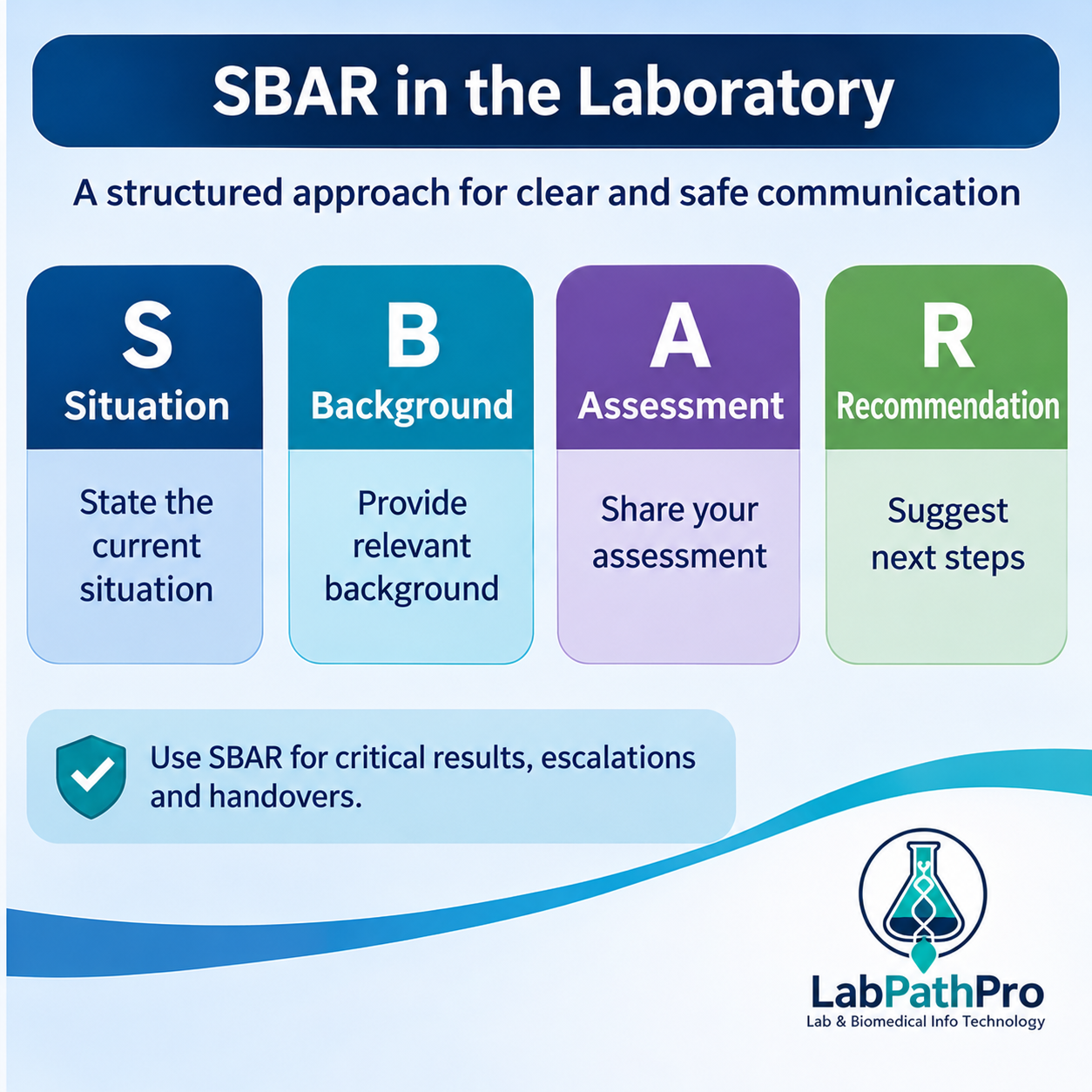
Seven-day articulation practice plan for Biomedical Scientists
You do not need a lengthy course to begin practising. Set aside approximately 10–15 minutes each day. The activities below are suggested learning exercises, not a validated clinical training programme.
| Day | Focus | Practical exercise |
|---|---|---|
| 1 | Baseline | Record a 60-second introduction describing your laboratory role, strengths and training. |
| 2 | Clarity | Explain IQC, calibration and haemolysis in plain English. Check that the definitions are accurate. |
| 3 | Structure | Explain a laboratory problem using issue → checks → action → outcome. |
| 4 | Applications | Choose one essential criterion from an NHS person specification and write a genuine evidence-based example. |
| 5 | Interviews | Record a STAR answer to a teamwork, troubleshooting or patient-safety question. |
| 6 | Audience | Explain the same laboratory concept to a trainee and to a non-specialist. |
| 7 | Review | Complete a short mock interview. Listen back and identify two changes to practise. |
A simple self-assessment checklist
After recording an answer, ask yourself:
- Did I answer the question directly?
- Was the main message clear within the first few sentences?
- Was my explanation scientifically accurate?
- Did I describe my own contribution honestly?
- Did I avoid unexplained jargon and unnecessary repetition?
- Did I keep within my professional scope of practice?
- Was my pace comfortable and my language respectful?
Improvement is easier to identify when you compare the first and final recordings using the same questions.
Common mistakes and practical solutions
| Common difficulty | Better approach |
|---|---|
| Talking for too long before answering | State the main point first, then give supporting detail. |
| Using technical terms without explanation | Define the term or choose language suited to the audience. |
| Claiming “excellent communication” without evidence | Describe a real handover, explanation, escalation or teaching example. |
| Memorising a full interview script | Memorise the structure and key facts, not every sentence. |
| Describing what the team did but not your contribution | Explain your actions and acknowledge supervision or collaboration. |
| Speaking beyond your knowledge or competence | Explain what you know, recognise limits and describe when you would seek advice. |
| Forgetting the outcome | Say what happened and, where appropriate, what you learned. |
Inclusive communication: accents, confidence and reasonable adjustments
Being an effective communicator does not require a particular accent, a loud voice or an extroverted personality. An accent is not evidence of poor competence. Multilingual professionals often bring valuable communication skills and experience to healthcare teams.
Individuals may also communicate differently because of stammering, hearing differences, autism, anxiety or other disabilities and conditions. Professional development should support accessible communication rather than pressure everyone to adopt one speaking style.
Where appropriate, disabled candidates can request reasonable adjustments during recruitment. NHS Employers provides guidance on accessible recruitment and adjustments. Applicants should contact the recruiting organisation about their individual needs and the arrangements available.
If speech production itself is persistently difficult or a person has concerns about a speech disorder, an appropriately qualified speech and language therapist may be more suitable than generic public-speaking exercises.
Frequently asked questions
Can articulation training help with NHS interviews?
It can help applicants give more organised, relevant and understandable answers. It cannot guarantee a job offer: recruitment also depends on meeting the person specification, demonstrable competence, the selection process and the other applicants.
Do I need to change my accent?
No. Focus on intelligibility, suitable pace, accurate terminology and checking that your message has been understood. Accent modification is not a requirement for professional communication.
Is articulation training an HCPC requirement?
No formal course called “articulation training” is required by the HCPC. However, effective communication is an explicit professional expectation within the HCPC standards for Biomedical Scientists.
What is the difference between STAR and SBAR?
STAR helps explain a previous experience, particularly in interviews or supporting information. SBAR helps structure the communication of relevant information during a handover or safety-critical discussion. Neither replaces clinical procedures or professional judgement.
How can trainee Biomedical Scientists practise before their first Band 5 application?
Use experiences from supervised placements, portfolio work, practical training, university projects and appropriate employment. Practise explaining what you did, what you learned and how you recognised the limits of your responsibilities. Check the registration and experience requirements of each vacancy.
Can AI help me improve my application or interview answers?
AI may help organise your writing, suggest practice questions or identify unclear sentences. Do not use it to invent qualifications, clinical experience, incidents or results. Protect patient confidentiality: never upload identifiable patient information or restricted workplace material to an unapproved service.
Conclusion: communicate your competence with confidence
Strong scientific knowledge is essential in Biomedical Science, but the ability to explain that knowledge is also valuable. Articulation practice can help trainees describe their experience, help Biomedical Scientists communicate with colleagues and support job applicants in presenting accurate evidence of their strengths.
Start with one real laboratory example. Explain it clearly, record your response, listen back and improve the structure. Practise consistently and seek feedback from a trusted colleague, trainer or mentor.
The goal is not to sound impressive. It is to make your knowledge, decisions and professional contribution understandable.
Explore more learning and professional development resources at LabPathPro.com.
Continue learning
HCPC registration guidance · IBMS Registration Portfolio guide · CPD for Biomedical Scientists · Learning Centre
References and further reading
- Health and Care Professions Council. Standards of proficiency: Biomedical scientists. Effective 1 September 2023.
- Health and Care Professions Council. Standards of conduct, performance and ethics. Effective 1 September 2024.
- Health and Care Professions Council. Professions and protected titles.
- The Shrewsbury and Telford Hospital NHS Trust. Applicant guidance.
- North London Shared Services. Our step-by-step guide to applying for an NHS job.
- Health Education England. Preparing for the interview process.
- NHS Employers. Values-based recruitment. 2024.
- NHS England. Improving patient safety culture: A practical guide.
- NHS Employers. How to recruit and support disabled staff in the NHS.
Educational notice: The examples in this article are fictional illustrations and do not replace local SOPs, Trust policies, professional standards, supervision, authorisation limits or clinical advice.