
IT Outages in Pathology: How Laboratories Keep Patient Results Moving
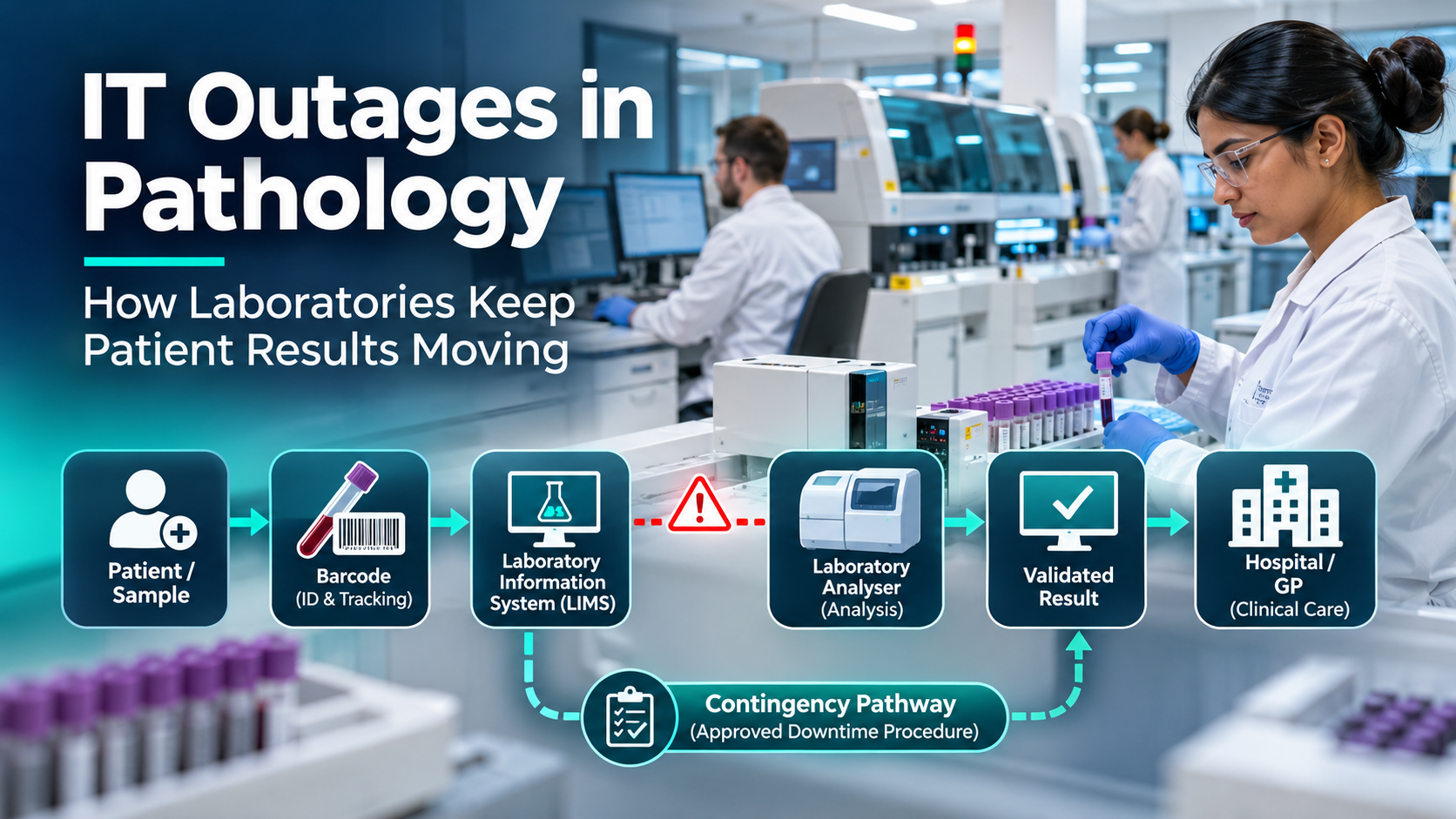
Introduction: when the digital connections we rely on stop working
On 12 November 2026, a major Microsoft 365 disruption began affecting users internationally. Outlook and Exchange Online were among the most visibly affected services, with problems accessing mailboxes and delays in sending or receiving email. Some other Microsoft 365 functions were also impaired, although the extent of disruption varied between services and organisations.
The issue quickly reached UK healthcare. NHS hospitals, GP practices and pharmacies reported difficulties with email or related administrative communication. Some organisations advised staff and patients to use telephone contact for urgent enquiries. Crucially, several NHS trusts stated that patient services and core clinical systems were continuing, despite problems with Microsoft applications. [1–6]
This was not evidence of a nationwide pathology LIMS failure. The verified incident largely demonstrated disruption to digital communication and dependent services. It nevertheless raises an important question: what happens if the systems involved in requesting, identifying, analysing, validating or transmitting a patient’s blood test become unavailable?
For Biomedical Scientists, knowing the answer is a matter of patient safety, not simply computer literacy.
What actually happened during the November 2026 Microsoft outage?
Microsoft incident reports for Exchange Online and Microsoft 365 described difficulty connecting to mailboxes via web and desktop applications and possible delays to email delivery. Its investigations identified abnormal infrastructure load, server instability and related authentication/routing issues during recovery efforts. At the time of writing, a complete, final root-cause report was not yet available; Microsoft said there was no evidence of malicious activity associated with the incident. [1]
NHS reports illustrate why an outage should never be described as though every digital system had failed. King’s College Hospital and Barts Health reported email disruption while patient services continued. The Queen Elizabeth Hospital King’s Lynn stated that clinical and patient-administration systems were working. Essex Integrated Care Board identified affected NHS email communication and provided alternative telephone arrangements. Community Pharmacy England distinguished problems in Microsoft-dependent communication from the separate core infrastructure of the Electronic Prescription Service and NHS Spine. [2–6]
A direct laboratory example was the North West Genomic Laboratory Hub, which advised users to telephone urgent enquiries because email was unavailable; it did not report that its analysers or LIMS had ceased functioning. [7]
The immediate lesson is simple: an IT outage is not a single type of failure. The effect on patients depends on which digital service is unavailable and what other systems depend on it.
Pathology is a digital service as well as a scientific service
When most people imagine a pathology laboratory, they picture blood samples, microscopes, reagents and automated analysers. All are important. Less visible are the connected information systems that move a sample from an electronic request to a result that a clinician can act upon.
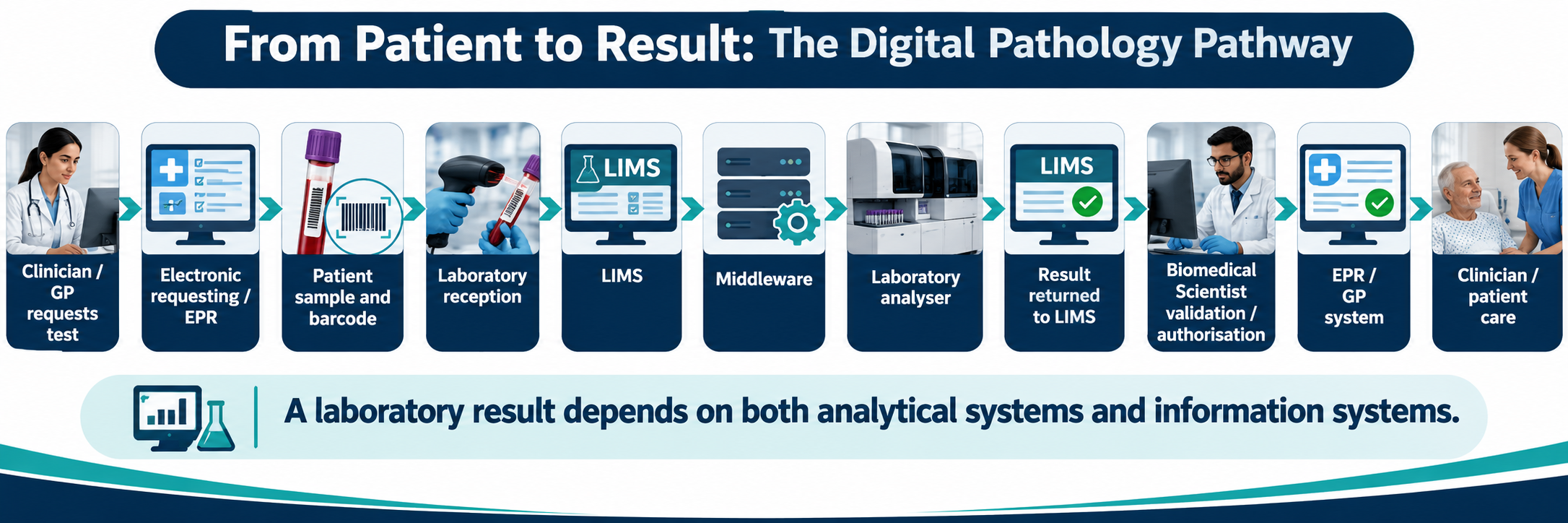
Consider a patient whose GP requests kidney function tests. The request may be entered into a GP clinical system and transmitted electronically. A sample is collected, labelled and transported to the laboratory. At specimen reception, identifiers and the requested tests are checked, and the sample is registered or recognised in a Laboratory Information Management System (LIMS). The LIMS and associated interfaces may transmit test orders to middleware and analysers. Results return from the analyser, undergo relevant quality and technical checks, and are authorised or released according to validated rules and laboratory policy. They are then transmitted to the clinician’s electronic record. [8]
The precise architecture differs between trusts, laboratories, specialities and analysers. It can include the following systems:
| System | What it does | Why it matters |
|---|---|---|
| EPR – Electronic Patient Record | Hospital digital patient record | Clinicians review requests, results and care information |
| Electronic requesting/order communications | Software for requesting tests | Ensures the correct test is requested for the correct patient |
| LIMS | Core laboratory information and workflow system | Registers and tracks specimens, results and their audit trail |
| Middleware | Software connecting and processing data between systems | Routes analyser orders/results and may support technical rules |
| Laboratory analyser | Equipment measuring substances or identifying organisms/cells | Generates the analytical finding |
| Integration engine / messaging | Connects different clinical applications | Transfers orders and authorised results |
| Microsoft 365 and other communication tools | Email, calendars, documents and collaboration | Supports clinical and administrative communication but is not normally the LIMS |
NHS England’s pathology architecture describes this complex interaction between patient systems, LIMS, middleware, analysers and result-reporting services. [8]
Physical samples and digital data follow different routes
A blood tube may travel on a conveyor, by porter or through an automated track. Its electronic request, test order, analyser results and report travel through software and networks. If a network connection fails, the tube may still reach the analyser, but the complete result pathway might no longer function normally.
Similarly, the analyser producing a number does not automatically mean that the result has been safely reported. Correct patient association, traceability, quality checks, authorisation and delivery to the intended clinician all remain essential.
Microsoft Outlook is not the pathology LIMS
Outlook, Teams, SharePoint and other collaborative applications support communication, meetings, documents and administrative workflows across hospitals. In some organisations, they may also support authorised referral or specialist laboratory correspondence. Their failure can delay enquiries and escalation even if the analyser and LIMS continue to operate.
A LIMS outage is different. It may interrupt sample registration, barcode or order handling, analyser interfaces, result validation, electronic transmission and the audit trail. In practice, laboratories must identify which system has failed before selecting the correct response.
| Type of disruption | Possible laboratory consequence | General response principle |
|---|---|---|
| Email or Microsoft 365 failure | Delayed enquiries, communications and coordination | Use approved alternate communications and confirm urgent receipt |
| Electronic requesting failure | New test requests may not reach the laboratory | Activate approved downtime requesting and identification |
| LIMS failure | Tracking, analyser orders, validation or reporting may be affected | Escalate and use validated downtime procedures, potentially restricting testing |
| Interface or network failure | Analyser data may not automatically transfer | Maintain traceability and implement authorised standalone/manual arrangements if available |
| Analyser failure | Selected testing capability unavailable | Follow analyser contingency, prioritisation and referral arrangements |
| Cybersecurity incident | Systems or networks may require deliberate isolation | Follow the organisation’s cyber incident instructions; do not reconnect systems independently |
These are illustrative categories, not instructions to bypass local SOPs. Each organisation must have risk-assessed procedures for its own configuration. [8–10]
What is a pathology business-continuity plan?
A business-continuity plan explains how a laboratory maintains an appropriate, safe service when normal arrangements are disrupted. It identifies essential services, who makes decisions, how staff communicate, which procedures can continue and what must be paused or referred elsewhere.
A disaster-recovery plan focuses more specifically on restoring IT systems and infrastructure. A backup is a preserved copy of information; it is important but does not by itself provide a safe method for receiving today’s specimens or delivering today’s critical results. NHS England expects documented, maintained and tested recovery and continuity arrangements. [9–10]
A practical laboratory contingency plan may cover: the declaration and escalation of downtime; who authorises reduced or manual testing; controlled paper requests and accession registers; specimen identification; alternative analyser workflows; quality control; critical-result communication; specimen storage; referral laboratory arrangements; cyber restrictions; and restoration and reconciliation.
The aim is not simply to keep the machines running. It is to preserve the safe end-to-end diagnostic service.
An illustrative laboratory downtime workflow
The following is an educational scenario, not a universal NHS policy. Actual actions, authorisation and documentation must follow local, validated procedures.
1. Recognise and escalate the problem. Confirm whether the failure affects email, order communications, the LIMS, middleware, an interface, an analyser or multiple systems. Notify the designated senior/incident team.
2. Establish the safe operating boundary. Determine which tests and functions remain available, which require additional controls and which must be suspended. Patients must not be exposed to unvalidated workarounds.
3. Activate approved downtime records. Use current paper or independent electronic forms where the organisation has authorised them. Record unique specimen and patient identifiers, requested tests, dates, times and staff actions.
4. Maintain specimen identification and traceability. Match the specimen to its request using approved identifiers. Do not invent temporary numbering schemes without authorisation or rely on memory.
5. Prioritise testing appropriately. Emergency and time-critical work may receive priority according to clinical and laboratory policy, taking account of the ability to perform the test accurately and communicate the result.
6. Preserve analytical quality. Appropriate quality control, calibration status, method limitations, staff competency and result validation remain relevant during downtime. A disconnected analyser is not automatically authorised for standalone use.
7. Communicate urgent or critical results through approved routes. Record the person contacted, result, time and any required confirmation or escalation in accordance with the relevant policy.
8. Retain all temporary records. Secure manual registers, printouts and communication logs under information-governance requirements.
9. Restore safely and reconcile. Confirm validated system and interface function. Check backlogs, electronic queues, duplicate requests, missing results, manual results, critical-result records and timestamps.
10. Review the incident. Identify problems, report relevant incidents, update procedures and use lessons learned in training and quality improvement.
NHS England’s clinical-messaging guidance recognises paper requests and manual result processes as potential contingency arrangements, subject to appropriate local controls. [9]
Critical results cannot wait for email to recover
One of the most important duties of a pathology service is to recognise and communicate critical or unexpected results appropriately. For example, a markedly abnormal potassium result may require prompt clinical action. The laboratory’s responsibility does not end when the analyser produces the value.
During a digital disruption, the professional team still needs an agreed way of verifying the result, checking patient and sample identity, contacting the correct clinical recipient, documenting the communication and escalating if the intended recipient cannot be reached. After recovery, the electronic record may also need to be updated and checked against the downtime documentation.
The Royal College of Pathologists’ 2026 recommendations emphasise robust communication systems and recording the details of critical-result communication. Numeric thresholds and escalation routes are locally defined; therefore this article deliberately does not prescribe a universal critical potassium threshold or telephone script. [11]
Patient-safety principle: A critical result remains critical when an email account, interface or LIMS is unavailable.
Recovery is more than switching the computer back on
A common assumption is that the incident ends as soon as the application becomes accessible. In reality, the recovery period can introduce another set of risks.
During downtime, results may be recorded on paper or analyser printouts, requests may be held, and electronic messages may remain queued. A restored interface may transmit delayed results while a staff member is simultaneously entering the same result manually. This creates potential duplication and discrepancy.
A controlled reconciliation process should therefore establish that every relevant specimen, request and result has one accurate, traceable record. It should account for delayed messages, unreported results, manual transcriptions, critical-result calls and outstanding referrals. The National Cyber Security Centre emphasises integrating information generated during manual workarounds into recovered systems safely. [12]
Restoring the server restores technology; reconciliation restores confidence in the patient record.
Cyberattack or ordinary outage: why the distinction matters
The Microsoft 365 disruption in November 2026 was not established to be a cyberattack, and many NHS clinical systems continued. By contrast, the 2024 ransomware attack affecting Synnovis directly disrupted pathology-related IT infrastructure, including systems connected to sample processing and result transmission. Extensive manual arrangements were required and testing capacity was affected. [1,13]
During a suspected cyberattack, ordinary recovery instincts can be dangerous. Analyser workstations and networks may need to remain isolated until a designated incident team authorises reconnection. Organisations therefore need cyber-specific business-continuity and recovery plans as well as general downtime procedures. [14]
The professional responsibility of Biomedical Scientists
A Biomedical Scientist’s responsibility extends beyond analysing a specimen. It includes understanding the limitations of equipment and methods, recognising risks in specimen handling and reporting, working within competence, protecting information and taking appropriate action when safety is threatened.
During an IT incident, this may involve identifying a broken pathway, recognising when safe testing cannot continue, prioritising essential work, recording evidence of manual activity, communicating with clinical teams, escalating discrepancies and contributing to incident review.
For trainees, the crucial learning point is that the pre-analytical and post-analytical stages can be as important to patient safety as the analytical measurement itself.
How does this link to the IBMS Registration Training Portfolio?
The IBMS Registration Training Portfolio Version 5 is aligned with HCPC Standards of Proficiency. Two especially relevant areas are Section 1, Module 3: Communication and Section 1, Module 4: Patient Records and Data Handling. [15]
Section 1, Module 3: Communication
This module addresses effective communication within the laboratory and with service users, including digital communication, telephone conversations and the reporting of laboratory information. An email outage offers a practical discussion of why a communication channel must be appropriate, secure and reliable, and why sending a message is not the same as confirming it has been received.
A trainee could reflect on the communication systems available in their own department and how staff use approved alternatives when the usual method is unavailable. The module’s mandatory task maps to HCPC standards 7.7, 7.8 and 7.9. [15]
Section 1, Module 4: Patient Records and Data Handling
This module follows the sample pathway and addresses clinical records, confidentiality, request/result errors, specimen identification, barcoding and backup storage. A LIMS downtime scenario helps trainees understand why each electronic step has a patient-safety purpose and what risks arise when it is missing. [15]
The module’s mandatory evidence maps to HCPC standards 6.2, 6.5 and 9.3, with additional mapped standards addressed through candidate-choice evidence. Candidates should consult the current IBMS module descriptors and their training officer for the precise evidence requirements.
Quality and continuing professional development
Staff involved in incident reporting, downtime exercises, audit, controlled documentation or quality improvement may also have relevant learning for quality management and CPD. Learning is not the same as competence: simply reading this article does not satisfy an IBMS portfolio requirement, and evidence must be authentic, appropriately mapped and assessed.
Relevant HCPC Standards of Proficiency
The current HCPC Biomedical Scientist standards, effective from September 2023, make digital competence, records, identification and risk part of professional practice. [16]
| Standard | What it means for pathology IT |
|---|---|
| 6.2 | Information and data governance |
| 6.5 | Confidentiality in digital and other communication |
| 7.7 | Appropriate information, communication and digital technologies |
| 7.9 | Communicating outcomes of biomedical procedures |
| 9.1–9.3 | Accurate records, management of information and digital record keeping |
| 9.4 | Risk of errors and omissions in laboratory requests and results |
| 9.5–9.6 | Correct patient/specimen identification and electronic identification systems |
| 9.7 | Importance of electronic data backup |
| 13.1 | Adapting practice as technologies and circumstances change |
| 13.14 | Validating scientific and technical data against quality standards |
| 13.18 | Working according to standard operating procedures |
| 13.22 | Implications of non-analytical errors |
| 14.5 | Safe practice environments and risk management |
These are concise educational descriptions rather than verbatim standards. Always refer to HCPC’s official wording for formal evidence mapping. [16]
ISO 15189:2022: why downtime procedures are a quality issue
ISO 15189:2022 provides quality and competence requirements for medical laboratories. Its relevant provisions include 7.6, control of data and information management—including information-system downtime arrangements—and 7.8, continuity and emergency preparedness planning. [17]
A written procedure that nobody can access or apply during an incident offers little protection. Laboratories need usable, risk-assessed arrangements and staff who understand their responsibilities. Appropriate exercises, documentation, audit and corrective action help test whether those arrangements work in practice.
Confidentiality does not disappear during an outage
Blood-test results are sensitive health information. UK GDPR treats health data as special-category personal data. [18]
Emergency workarounds must still preserve confidentiality, integrity and availability. A personal messaging account, unsecured paper register or unapproved spreadsheet could introduce new risks even if it appears to solve an urgent communication problem. Use only authorised pathways and follow organisational information-governance instructions.
Learning exercise: what would you do in your own laboratory?
Imagine that the LIMS becomes unavailable during a busy morning shift. Analysers appear operational, several urgent samples have arrived, and the emergency department is awaiting results.
Question 1 – Identification: How would your department maintain the link between the correct patient, specimen, requested tests and resulting report?
Question 2 – Analysis: Which tests could safely continue, who would authorise a downtime workflow, and what quality checks would still be required?
Question 3 – Communication: How would a time-critical result be communicated, documented and escalated if the normal recipient could not be reached?
Question 4 – Recovery: What records, pending messages and manual results would require reconciliation when the LIMS returned?
Question 5 – Reflection: Which HCPC standards and IBMS portfolio requirements does this scenario illustrate, and how would you demonstrate your own competence using local SOPs and authentic experience?
These are reflective learning questions, not a model portfolio answer. They should be answered using local departmental policies and discussed with a training officer or authorised assessor.
What should patients know?
Does an IT outage mean my blood test cannot be processed? Not necessarily. Different systems support different parts of care, and an email outage does not automatically stop laboratory testing. More extensive failures can cause delays to sample processing or result reporting. Healthcare services use contingency arrangements to prioritise essential activities safely.
Will my test result be lost? Laboratories have record-management, backup and continuity processes, but the actual effect depends on the incident. The laboratory and clinical team must verify that requests and results are properly accounted for.
What should I do if I am awaiting results? Follow advice from the GP practice or hospital responsible for your care. If a service has announced an alternative contact number, use its official communication channels. Do not assume an emailed message has reached the intended team during a known outage.
Lessons for the future
Digital technologies have improved laboratory medicine through faster requests, accurate traceability, efficient automation, standardised communication and rapid availability of results. The lesson from the November 2026 Microsoft incident is not that these technologies should be abandoned. It is that reliance on interconnected systems must be matched by proportionate resilience.
That resilience requires independent communication options, safe laboratory downtime procedures, tested backups and recovery arrangements, cybersecurity, trained staff, reliable audit trails and careful reconciliation after restoration. It also requires Biomedical Scientists who understand how a laboratory result travels from the patient to the clinician—not only how the analyser makes the measurement.
A reliable laboratory result is more than a number. It must belong to the right patient, remain traceable, meet analytical quality requirements and reach the right clinical team safely—even when technology fails.
References and further reading
- University of Pennsylvania, Microsoft 365 incident-report extract for MO1550821/EX1550543: Read source
- NHS Essex Integrated Care Board, temporary disruption to NHS email services, November 2026: Read source
- King’s College Hospital NHS Foundation Trust, Microsoft outage: Read source
- Barts Health NHS Trust, Microsoft outage update: Read source
- The Queen Elizabeth Hospital King’s Lynn, service updates: Read source
- Community Pharmacy England, some NHS systems affected by Microsoft outage: Read source
- North West Genomic Laboratory Hub: Read source
- NHS England, Pathology diagnostic pillar: Read source
- NHS England, Clinical messaging and test results: Read source
- NHS England, Disaster recovery and business continuity: Read source
- Royal College of Pathologists, G158, Communication of critical and unexpected pathology results (2026): Read source
- National Cyber Security Centre, Prepare your technical recovery capability: Read source
- Synnovis cyberattack information centre: Read source
- NHS England, pathology-specific network-security principles: Read source
- IBMS, Registration Training Portfolio V5 module descriptors guidance: Read source
- HCPC, Standards of Proficiency – Biomedical Scientists: Read source
- ISO, ISO 15189:2022 Medical Laboratories – Requirements for Quality and Competence: Read source
- Information Commissioner’s Office, What is special category data?: Read source
Editorial note: Reporting about the November 2026 Microsoft outage reflects the information available on 13 November 2026. Technical cause, recovery status and institutional impacts may be updated as further verified incident information becomes available.
Educational disclaimer: This article does not replace local laboratory standard operating procedures, organisational incident management, professional guidance or clinical advice. Illustrated workflows are hypothetical, and no claim is made that a nationwide pathology LIMS outage occurred during the Microsoft 365 incident.