
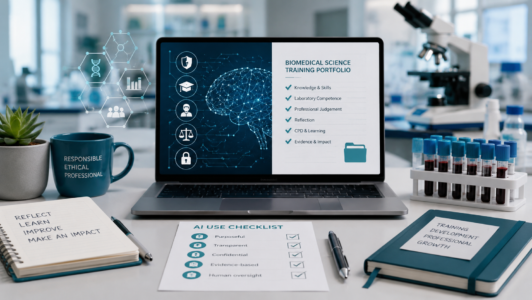
Using Artificial Intelligence During Biomedical Science Training and Portfolio Completion
A practical guide for students, trainees and IBMS portfolio candidates
Artificial Intelligence, often called AI, is now part of everyday digital life. Many students and trainees use tools such as ChatGPT, Microsoft Copilot and Google Gemini to help with writing, study, reflection and professional development. These tools can be useful, but they must be used carefully, especially when completing an IBMS qualification or registration portfolio.
The key message is simple: AI can support your learning, but it must not replace your own knowledge, judgement, reflection or professional competence.
During biomedical science training, your portfolio is not just a written assignment. It is evidence that you are developing the knowledge, skills, behaviour and professional judgement required to practise safely. This means that any evidence you submit must genuinely reflect your own work, your own experience and your own understanding.
Why AI Use Matters in Biomedical Science Training
Biomedical scientists work in a profession where accuracy, honesty, confidentiality and patient safety are essential. The work completed during training must show that a trainee can think critically, follow professional standards and apply knowledge safely in practice.
AI can produce written answers that sound confident and professional. However, AI does not understand biomedical science, laboratory practice or patient safety in the same way as a trained professional. It may generate information that is incomplete, inaccurate or not relevant to your local laboratory practice.
This is why trainees must not rely on AI-generated content without checking it carefully. If you include information that you do not understand, cannot explain or cannot apply to your own work, this may raise concerns about the authenticity of your evidence and your readiness for safe professional practice.
The Main Principle: AI Should Assist, Not Replace
AI may be used to support learning, but it should not complete the learning for you.
Acceptable use of AI may include:
- helping you organise your ideas;
- suggesting a structure for a draft;
- improving spelling, grammar or clarity;
- helping you think about reflective questions;
- suggesting areas you may wish to read about further.
However, AI should not be used to write your portfolio evidence for you. It should not be used to fill gaps in your knowledge, create reflections you did not personally experience, or produce content that you cannot explain in your own words.
A useful way to think about this is:
AI can help you prepare, but it must not become the author of your evidence.
Your Portfolio Must Remain Your Own Work
When you submit portfolio evidence, you are confirming that the work represents your own knowledge, understanding and experience. This is especially important in reflective writing, workplace case studies, quality incident reviews, audit evidence, health and safety tasks and evidence linked to local laboratory procedures.
Your Training Officer, mentor, tutor or verifier may ask you to explain your evidence verbally. You should be able to discuss:
- what you did;
- why you did it;
- what you learned;
- how it links to your workplace practice;
- how it demonstrates the relevant professional standards;
- how you developed the evidence.
If you cannot explain your work clearly, this may suggest that the evidence does not fully reflect your own understanding.
Be Transparent About AI Use
Transparency is an important part of professional integrity. If you use AI to support your work, you may be asked to declare this.
A declaration may include:
- the name of the AI tool used;
- how the tool was used;
- whether it helped with structure, grammar, reflection prompts or further reading;
- how you checked and adapted the content yourself.
Being open about responsible AI use is better than hiding it. If AI use is not declared where required, it may be viewed as plagiarism or academic misconduct.
A simple example of an AI declaration could be:
“I confirm that this evidence is my own work and reflects my own knowledge, understanding and laboratory experience. I used [name of AI tool] only to support [for example, grammar checking, structure or reflective prompts]. I reviewed, checked and edited the final work myself and can explain the evidence in relation to my own practice.”
What Counts as Acceptable AI Use?
AI may be acceptable when it helps you think, organise or improve your own work.
For example, if you are writing a reflection on a quality incident that you personally participated in, you could ask AI to suggest reflective questions. You could then use those questions to help write your reflection in your own words.
You could also ask AI to check spelling and grammar in a draft that you have already written. This is different from asking AI to write the reflection for you.
Another acceptable example is creating your own draft diagram or flowchart and asking AI to suggest whether the structure is clear. You must still check any suggestions against your own knowledge and local procedures. You should not upload confidential laboratory documents or internal standard operating procedures into AI tools.
What Counts as Unacceptable AI Use?
Unacceptable AI use includes asking AI to generate your evidence for you and then submitting it as your own work.
Examples of unacceptable use include:
- asking AI to write a full portfolio reflection;
- copying and pasting AI-generated content into your evidence;
- asking AI to correct scientific errors that you do not understand;
- using AI to add information that you cannot explain;
- uploading internal laboratory documents without permission;
- uploading patient-identifiable information;
- submitting content that does not reflect your own experience.
This type of AI use can undermine the purpose of the portfolio. It may also create concerns about academic integrity, professional honesty and patient safety.
Do Not Upload Patient Information or Confidential Documents
Trainees must never upload identifiable or recognisable patient information into AI tools. This includes patient names, NHS numbers, hospital numbers, dates of birth, clinical histories or any other information that could identify a patient.
You should also avoid uploading internal laboratory documents unless your employer or placement provider has clearly agreed that this is allowed. This may include:
- local standard operating procedures;
- incident reports;
- audit reports;
- validation documents;
- screenshots from laboratory information systems;
- internal training documents;
- confidential Trust documents.
In NHS laboratory practice, confidentiality and information governance are essential. AI use must not create a risk of breaching UK GDPR, professional confidentiality or local organisational policy.
AI Is Not a Reliable Authority
AI tools can produce text that appears accurate, but this does not mean the information is correct. AI predicts likely responses based on patterns in data. It does not understand your local workplace, your training history, your analyser platforms, your laboratory procedures or your professional responsibilities.
This means that any AI-generated suggestion must be checked carefully. You remain responsible for anything you submit.
You should verify information using appropriate sources, such as your training materials, local procedures, approved guidance, professional standards and discussions with your Training Officer or mentor.
Professional Discussion Is Part of the Process
Your Training Officer, mentor or verifier may ask questions about your evidence. This should not be seen as a punishment. It is a normal part of confirming that the work is authentic and that you understand what you have submitted.
You may be asked:
- how you approached the evidence;
- whether AI was used;
- what prompts were used;
- how you changed the draft;
- what you learned from the task;
- how the evidence links to your practice;
- how you would apply the learning in the laboratory.
This type of discussion helps confirm that the evidence is genuinely yours and that you are developing safe professional judgement.
Guidance for Trainees Completing an IBMS Portfolio
When using AI during your portfolio, follow these principles:
- Write from your own experience. Your evidence should be based on what you have done, observed, learned or reflected on during training.
- Use AI only for support. It may help you organise your ideas or improve your writing, but it should not create the substance of your evidence.
- Be honest. If AI has been used, declare it where required.
- Protect confidentiality. Do not upload patient information, internal documents or sensitive laboratory material.
- Check everything. Do not include information unless you understand it and know it is correct.
- Keep evidence of your process. It may be useful to keep drafts, notes, prompts or records showing how you developed your work.
- Prepare to explain your evidence verbally. You should be able to defend the work in your own words.
Guidance for Trainers and Mentors
Training Officers, mentors and verifiers should not assume that all AI use is inappropriate. The aim should be to support responsible, transparent and ethical use.
Trainers should explain to learners what is acceptable and unacceptable. This helps reduce confusion and encourages honesty.
When reviewing evidence, trainers should consider whether the work:
- reflects the learner’s own workplace experience;
- includes appropriate local context;
- demonstrates professional judgement;
- shows reflection and learning;
- can be explained verbally by the learner;
- avoids confidential or identifiable information;
- clearly maps to the required standards.
AI-detection tools may support professional judgement, but they should not be used as the only method of deciding whether work is authentic. A high or low AI score does not prove whether evidence is genuine. Professional discussion remains a more reliable way to explore authenticity.
If a learner cannot explain their submitted evidence, progression should be paused until the trainer is satisfied that the work is authentic and that the learner is safe and competent to progress.
Making Portfolio Tasks More Authentic
Portfolio evidence is stronger when it is clearly linked to the learner’s own workplace. This makes it harder for AI to generate generic answers and helps trainees demonstrate real competence.
Good evidence should include:
- recent workplace experience;
- local laboratory processes;
- local equipment or analyser platforms;
- reflection on actual challenges;
- examples of decision-making;
- evidence of professional judgement;
- discussion of what the trainee learned;
- clear links to relevant standards.
For example, a generic explanation of quality control is weaker than a reflection on how the trainee responded to an internal quality control issue in their own laboratory, what escalation process was followed, what was learned and how this improved future practice.
Practical Examples
A trainee writing about specimen rejection could use AI to help organise headings, such as “sample receipt”, “identification checks”, “rejection criteria”, “communication” and “reflection”. However, the trainee must write the content using their own understanding of local practice and must not upload the local SOP into the AI tool.
A trainee writing a reflection on communication could ask AI for reflective prompts, such as “What went well?”, “What could I improve?” and “How did I adapt my communication?” The final reflection must still be based on the trainee’s own experience.
A trainee preparing evidence on a quality audit could use AI to check grammar after writing the evidence. However, they must not ask AI to create the audit summary from confidential documents or internal reports.
Conclusion
AI can be a useful tool for biomedical science students and trainees when it is used responsibly. It can help with structure, clarity, grammar, reflection prompts and study planning. However, it must not replace personal learning, professional judgement or genuine workplace experience.
The safest approach is to treat AI as a support tool, not as a source of professional authority. Your submitted portfolio evidence must remain your own work. You must understand it, be able to explain it and be able to show how it relates to your own laboratory practice.
For IBMS portfolio candidates, the core message is clear:
Use AI to support your learning, but make sure your portfolio demonstrates your own competence.
References
Institute of Biomedical Science. Guidance for Learners on the Use of Generative AI: To support candidates undertaking IBMS qualifications. Version 1.0. May 2026.
Institute of Biomedical Science. Guidance and Support on the Use of Generative AI: To support candidates undertaking IBMS qualifications. Version 1.0. April 2026.
“`