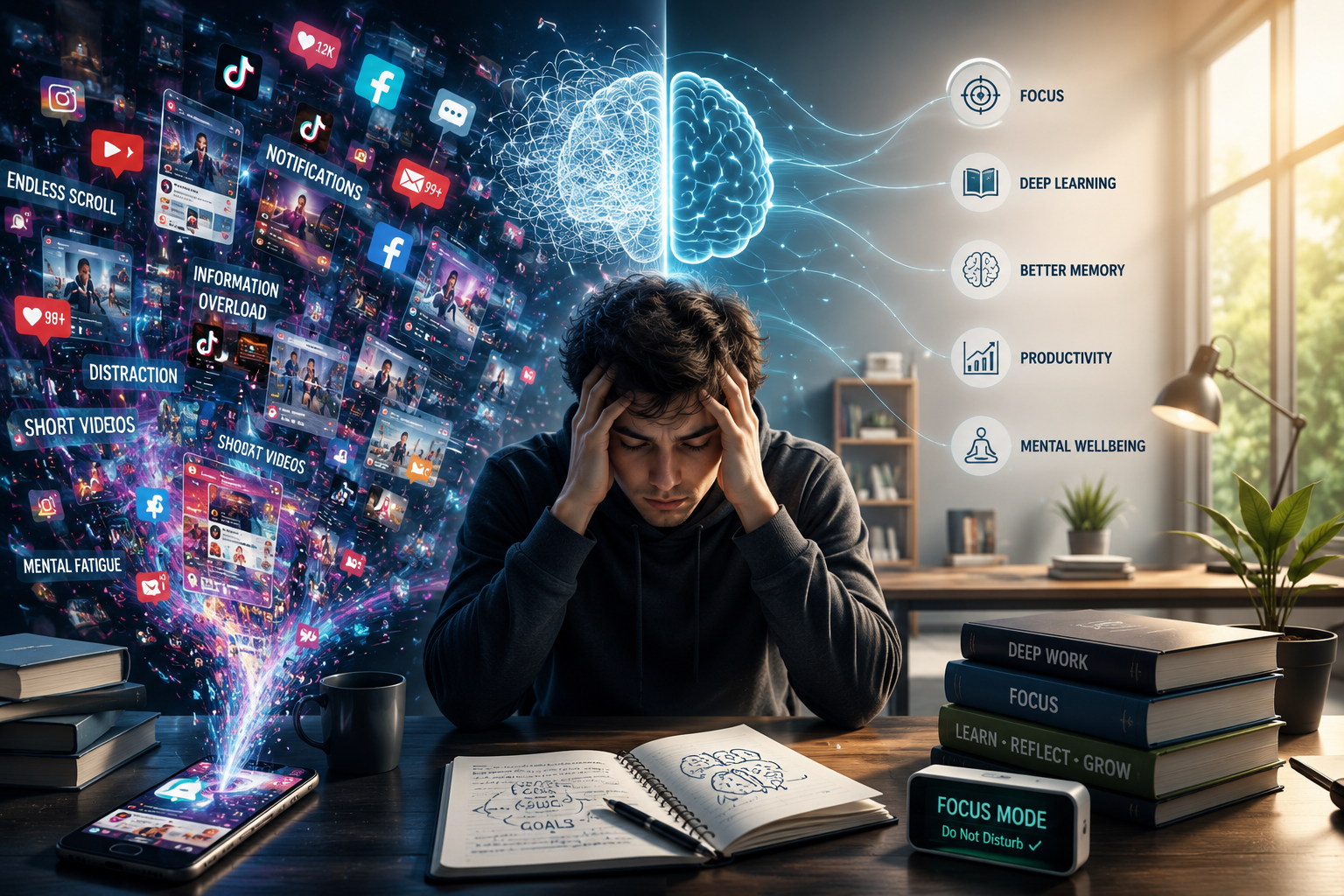
Learn how short-form social media content affects attention, memory, stress, and mental wellbeing. Discover evidence-based strategies to improve focus, productivity, and digital wellbeing.




-
Introduction
-
Why Short Videos Feel So Addictive
-
How Information Overload Affects the Brain
-
Reduced Attention Span
-
Poor Memory Retention
-
Increased Stress and Anxiety
-
Mental Fatigue and Productivity Loss
-
What Current Research Says
-
Signs You May Be Experiencing Information Overload
-
Practical Solutions Backed by Research
-
Protect Your Attention
-
Consume Information Intentionally
-
Improve Information Retention
-
Build Healthy Digital Habits
-
A Simple Daily Routine for Better Focus
-
Best Apps and Tools for Digital Wellbeing
-
Final Thoughts
-
Key References
Introduction
We live in a world where information is available everywhere — TikTok videos, YouTube Shorts, Facebook Reels, Instagram clips, news feeds, podcasts, and constant notifications. While technology gives us instant access to knowledge, it also creates a serious modern challenge: information overload.
Many people now feel:
- Mentally exhausted
- Easily distracted
- Unable to focus deeply
- Overwhelmed by endless scrolling
- Forgetful despite consuming large amounts of content
Scientific research increasingly shows that short-form social media content can negatively affect attention, memory, sleep, and mental wellbeing when consumed excessively.
Why Short Videos Feel So Addictive
Modern social media platforms are designed to keep users scrolling continuously by using:
- Constant novelty
- Fast emotional stimulation
- Algorithmic recommendations
- Infinite feeds
- Unpredictable rewards
Each swipe introduces a new topic, emotion, or surprise. This repeated “context switching” keeps the brain highly stimulated but also mentally fragmented.
How Information Overload Affects the Brain
Reduced Attention Span
The brain struggles to focus deeply when interrupted continuously. Over time, sustained concentration becomes more difficult.
Poor Memory Retention
Watching hundreds of short clips does not mean the brain stores the information properly. Much of the content is forgotten quickly because it was never deeply processed.
Increased Stress and Anxiety
Constant notifications and endless information streams keep the brain in a state of alertness and overstimulation.
Mental Fatigue
Too much information reduces decision-making quality and can leave people feeling emotionally drained.
What Research Says
A large 2025 meta-analysis involving over 98,000 participants found that heavy short-form video use was associated with:
- Poorer attention
- Reduced inhibitory control
- Higher stress levels
- Increased anxiety
The strongest effects were linked to compulsive and uncontrolled use rather than occasional purposeful use.
Signs You May Be Experiencing Information Overload
- Constantly checking your phone
- Difficulty reading long articles or books
- Forgetting information quickly
- Feeling mentally “foggy”
- Reduced productivity
- Trouble sleeping
- Feeling anxious without checking notifications
Practical Solutions Backed by Research
- Protect Your Attention
- Turn off non-essential notifications
- Keep your phone away during deep work
- Use Focus Mode or app timers
- Avoid multitasking
- Consume Information Intentionally
Before watching something, ask:
- Is this useful?
- Is the source credible?
- Will this matter next week?
- Am I learning or just being entertained?
- Improve Information Retention
Research shows that active learning works far better than passive scrolling.
Better methods include:
- Writing notes
- Creating flashcards
- Retrieval practice
- Spaced repetition
- Summarising content in your own words
- Build Healthy Digital Habits
- No scrolling immediately after waking
- No short videos before sleep
- Schedule fixed social media times
- Take regular digital breaks
A Simple Daily Routine
Morning
- Avoid social media for the first 30 minutes
- Set 1–3 important goals for the day
During the Day
- Use social media in short, planned sessions
- Save only genuinely useful information
- Convert useful content into notes or reminders
Evening
- Review key information briefly
- Avoid endless scrolling before bed
Best Apps and Tools for Digital Wellbeing
- Apple Screen Time
- Android Digital Wellbeing
- YouTube “Take a Break” reminders
- TikTok screen-time management tools
- Facebook Feed Controls
- Freedom App
- One Sec App
- Anki Flashcards
These tools can help reduce distractions, improve focus, and build healthier digital habits.
Final Thoughts
Social media itself is not the enemy. The real problem is uncontrolled consumption, constant interruption, and passive endless scrolling.
Technology should serve your goals — not control your attention.
The most successful people in the modern information age are not those who consume the most information, but those who:
- Filter wisely
- Focus deeply
- Retain meaningful knowledge
- Protect their attention
In today’s world, attention is one of the most valuable resources we have.
Key References
- Nguyen L et al. – “Feeds, Feelings, and Focus: A Systematic Review and Meta-Analysis Examining the Cognitive and Mental Health Correlates of Short-Form Video Use” (2025)
- Shannon H et al. – “Problematic Social Media Use in Adolescents and Young Adults: Systematic Review and Meta-Analysis” (JMIR Mental Health, 2022)
- Castelo N et al. – “Blocking Mobile Internet on Smartphones Improves Sustained Attention and Wellbeing” (PNAS Nexus, 2025)
- Fitz N & Kushlev K et al. – “Batching Smartphone Notifications Can Improve Well-Being” (Computers in Human Behavior, 2019)
- Wei M et al. – “Fragmented Learning from Short Videos Modulates Neural Activity During Memory Retrieval” (npj Science of Learning, 2026)
- Rowland CA – “The Effect of Testing Versus Restudy on Retention: A Meta-Analytic Review” (Psychological Bulletin, 2014)
- Kashlot S et al. – “Strategies for Managing Information Overload: A Systematic Review” (Journal of Documentation, 2026)
Sign up for free class
It’s easy and free!