
When I first arrived in the UK as an international student, I wasn’t quite sure where my career path would take me.
Back in Pakistan, my academic background included Botany, Zoology, and both Organic and Inorganic Chemistry—classic BSc modules with a strong theory base, but little exposure to healthcare professions. I was passionate about science and wanted a hands-on, vocational healthcare role. I explored fields like Nursing and Radiography, but none seemed quite the right fit.
Then I discovered Biomedical Science—a degree that perfectly combined theory with diagnostic application, and one that quietly operates at the core of patient care.

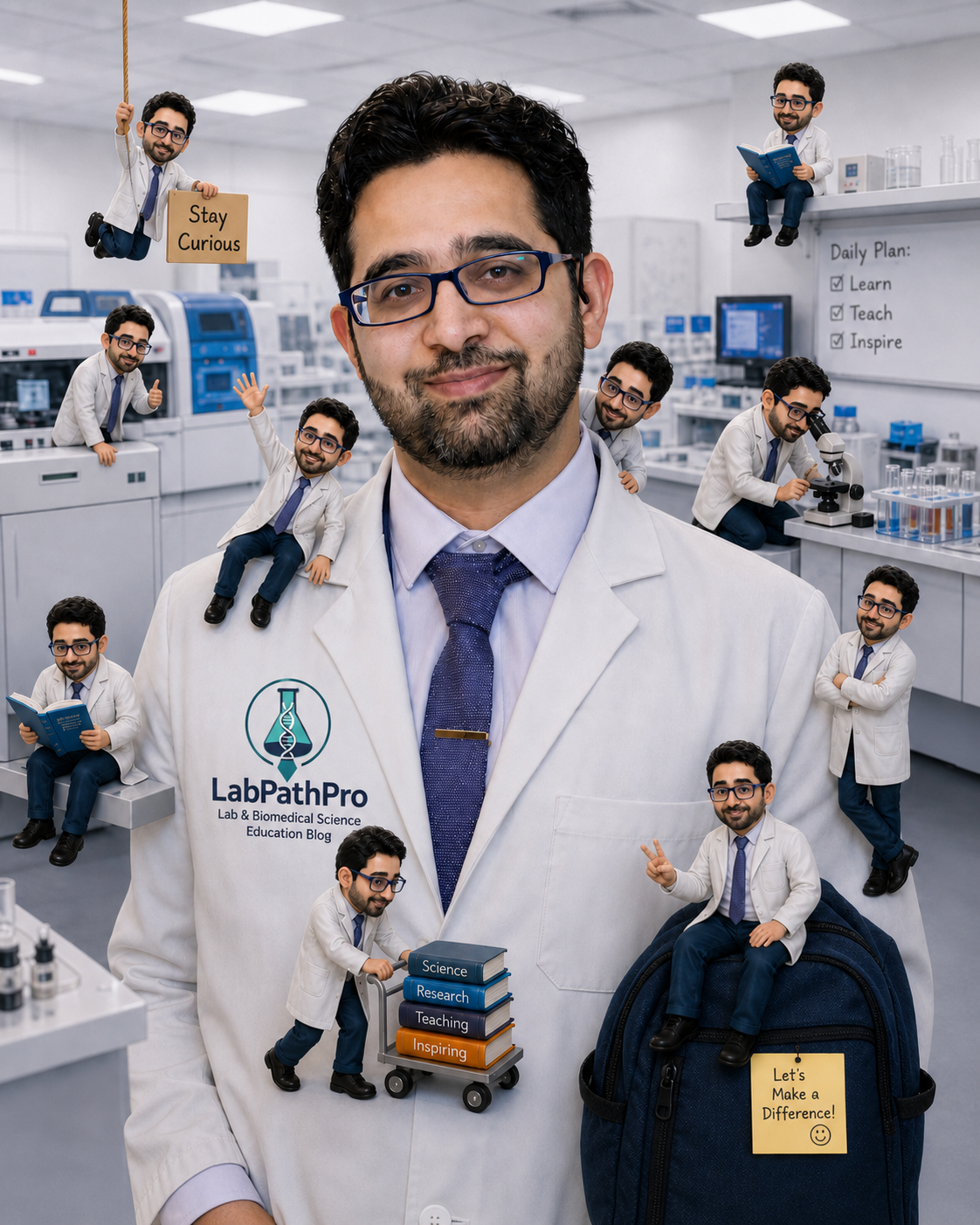

Here is a summary of the key milestones and qualifications that shaped my journey from student to HCPC-registered Biomedical Scientist:
Foundation Stage
Degree Qualification
Registration Pathway
Specialisation & Further Study
Educational Leadership
Although my academic training gave me a strong scientific foundation, there were gaps that I only recognised once I entered the laboratory workplace:
Limited Laboratory Exposure
Due to the lack of a placement year, I missed early exposure to the clinical laboratory environment—how workflows function, what instruments are used, and what is expected in a real diagnostic setting.
Discipline Uncertainty
During my degree, I had no clear idea I’d specialise in Clinical Chemistry. Had I known, I would have chosen more advanced chemistry modules or explored this field in greater depth.
Lack of Practical Automation Knowledge
Our lectures briefly mentioned analysers, automation, and laboratory information systems—but didn’t offer hands-on experience. It took time and additional training to build this essential understanding.
Whether you are just starting your Biomedical Science degree or considering a healthcare career, here’s what I would suggest:
Today, I proudly serve as a Deputy Training Lead and Specialist Biomedical Scientist in Clinical Chemistry. I support:
Every Biomedical Scientist’s route is unique. Mine was not linear—it was full of decisions, detours, and delayed steps. But every stage added something valuable.
So if you’re reading this as a student, graduate, or overseas professional wondering, “Can I do this?” — the answer is yes.
You might need more time. You might take an indirect route. But with curiosity, commitment, and continuous learning, you’ll find your place in this incredible profession
Want to know how to start a BMS career, complete your IBMS portfolio, or partner with LabPathPro?
Explore our Q&A section or reach out—we’re here to help.

Want to know how to start a BMS career, complete your IBMS portfolio, or partner with LabPathPro?
Explore our Q&A section or reach out—we’re here to help. View more Q&A here
Lorem ipsum dolor sit amet, consectetur adipiscing elit. Ut elit tellus, luctus nec ullamcorper mattis, pulvinar dapibus leo.
Lorem ipsum dolor sit amet, consectetur adipiscing elit. Ut elit tellus, luctus nec ullamcorper mattis, pulvinar dapibus leo.
Lorem ipsum dolor sit amet, consectetur adipiscing elit. Ut elit tellus, luctus nec ullamcorper mattis, pulvinar dapibus leo.
Lorem ipsum dolor sit amet, consectetur adipiscing elit. Ut elit tellus, luctus nec ullamcorper mattis, pulvinar dapibus leo.
Lorem ipsum dolor sit amet, consectetur adipiscing elit. Ut elit tellus, luctus nec ullamcorper mattis, pulvinar dapibus leo.